

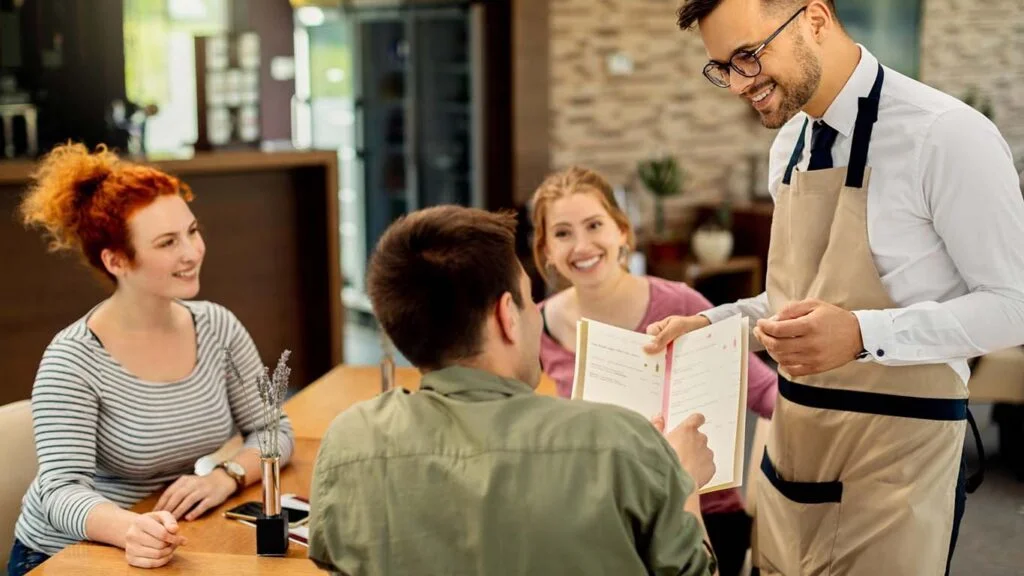
The key to the success of a restaurant is the quality of service that it maintains. Regular practices minimize mistakes and enhance employee work. SOP of restaurant service document gives step by step instructions to all front of house activities.
It guarantees that employees know about expectations of greetings, handling of orders, and table management. Through standard processes, the restaurants would be able to provide uniform service across shifts. SOPs are useful in training of staff, monitoring their performance, and their efficiency.
Formal service policies minimize customer complaints and increase customer satisfaction. Clear guidelines give employees the strength to work freely and professionally to ensure a smooth enjoyable dining experience to each and every guest.
Guest Interactions Standardization.
Each and every interaction with the guest is a reputational influence on a restaurant. SOPs state the explicit guidelines of welcoming customers, taking orders, and special request. A SOP restaurant service provides the same pattern of communication, table service as well as resolution of problems by the employees.
Standardized interactions produce a predictable and professional experience to all visitors. Employees will be able to solve problems effectively without misunderstanding. Reliability of service also creates trust among customers and makes them visit again.
Managers are able to track the compliance with the procedures and offer specific feedback. Through standardization of guest interaction, restaurants are able to ensure high standards of service and a loyal customer base is created.
Staff Onboarding And Training.
Delivery of consistent service requires proper training. SOPs are written guidelines that guide the onboarding of new employees, their roles and best practices. The SOP restaurant service manual assists employees to acquire skills within a short time when performing their duties such as placing tables, serving the menu, and communicating with customers.
Reference guides help to eliminate mistakes and accelerate learning. The SOP should also be reviewed regularly to keep the staff up to date with new protocol. Training that is well-organized will lead to increased confidence and efficiency, which translates to a streamlined day to day running.
Workers who are well trained on specific guidelines are of better service quality. Proper onboarding enhances the performance of employees, minimizes the turnover and makes service excellence in every shift uniform.
Enhancing Operational Effectiveness.
Inefficiencies in operation may slow down the service and the frustration of guests. SOPs have distinct protocols of taking orders, turning tables, and communication between front- and back-of-house employees. A standard operating procedure for a restaurant makes sure that the employees adhere to the most efficient procedures.
Simplified procedures reduce waiting times, errors and improve efficiency. Managers are in a position to track compliance and make evidence-based changes. Effective work processes enable employees to concentrate on the experience of guests instead of confusion in operations.
Efficiency leads to efficiency in services delivered, management of tables, and satisfaction. SOPs ensure the day-to-day activities are predictable and controllable enhancing the overall performance and profitability of the restaurant.
Multi-Location Consistency Support.
Chain restaurants will have to have consistent service standards. SOPs act as a focal point where all branches can rely on as the procedure is followed equally by all the locations.
A SOP restaurant service manual empowers the managers and franchisees to uphold quality, train employees and keep track of the performance. Documentation is centralized and as a result, audits, quality checks and tracking of performances are simplified.
The guests feel the same professional service no matter the location and this enhances the reputation of the brand. Multi-location consistency fosters loyalty and repeat business. Scalable service quality is only possible with SOPs, as restaurants can expand.
Conclusion
SOP restaurant service document is the key to efficient operation, training of staff, and the ability to provide regular experiences to guests. Standard procedures are better in enhancing communication, minimizing error and improving service quality.
The SOPs direct employees in all customer related areas such as greeting to order delivery and handling of complaints. They also present a clear guideline that managers can use to ensure that they are in compliance and enhance performance.
Organized service procedures enhance efficiency, multi-location conformity and brand recognition. The restaurants with successful SOPs establish the professional and trusting experiences of their guests, stimulating their satisfaction, loyalty, and the success of their business in the long term.