

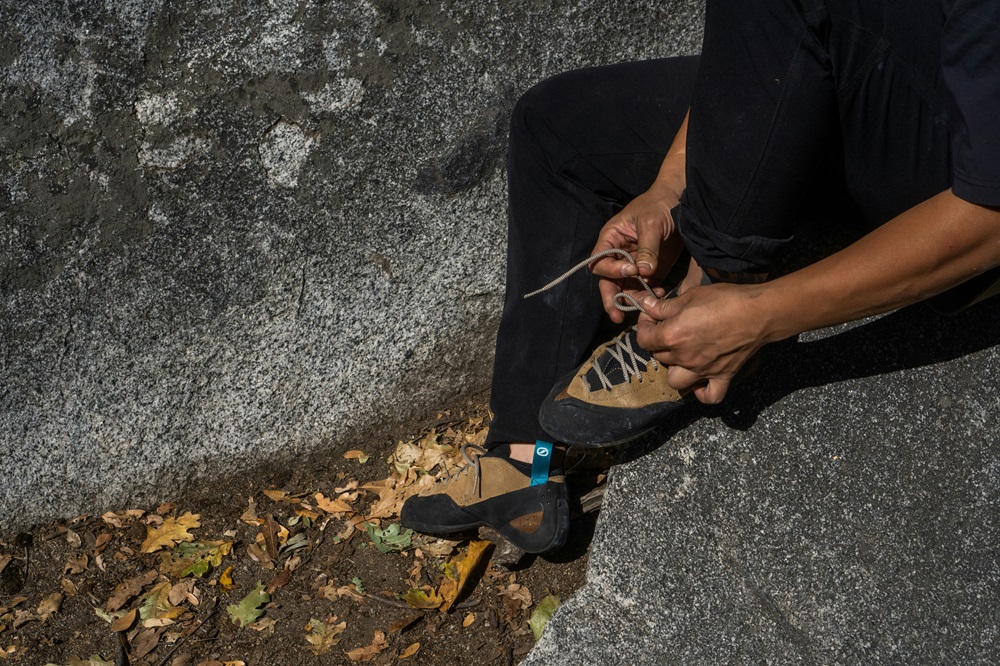
If you’ve been scanning every climbing shoes sale you can find, trying to figure out whether that painful new pair is worth keeping, you’re not alone. Shoe fit questions are one of the most common things new and intermediate climbers struggle with.
And the confusion makes sense. There’s a lot of conflicting advice out there, and the gap between “snug performance fit” and “my toes are screaming” is hard to judge when you’re new to it.
This article covers two of the most common questions climbers ask: why do new climbing shoes hurt so much, and what’s that weird triangular cutout on some shoes actually for?
The Great Sizing Debate: How Tight Is Too Tight?
If you’ve just bought a performance shoe and it feels unbearable standing still, the first thing you’ll hear from other climbers is: “That’s normal. Break them in.”
Sometimes that’s true. But sometimes it’s not.
Here’s a clearer way to think about it.
Snug is fine. Painful is a problem.
Your climbing shoes should be tight. Your toes should be touching the end of the shoe, and there shouldn’t be dead space anywhere. A slight curl in your toes is expected with performance shoes. But if you can’t stand in them for five minutes, can’t imagine stepping on a foothold without flinching, or feel a sharp shooting pain rather than just pressure, something is off.
The line between discomfort and pain is personal. But a useful test: can you stand on an edge for about 10 seconds without losing your mind? If you can barely manage that, the shoe may be too small for where you are right now in your climbing.
Does material matter for break-in?
Yes, a lot. Leather shoes stretch significantly over time. A snug leather shoe will often feel much better after a few sessions as it molds to your foot.
Synthetic shoes are different. The Tenaya Ra, for example, is synthetic and won’t stretch much. If it’s painful in the shop, it’ll still be painful after a month. That doesn’t mean you sized wrong, but it does mean you shouldn’t count on the material doing the work for you.
Your feet also adapt, not just the shoe.
This is something a lot of climbers overlook. Your feet get stronger and more used to the compressed position over time. What feels like a 7 out of 10 on the pain scale when you first put a shoe on can genuinely drop to a 1 or 2 after a few weeks of regular use. The toe position itself becomes more familiar to your foot.
So there are two things happening at once: the shoe adjusting slightly to you, and your foot adjusting to the shoe.
When is a fit actually too big?
Upsizing in climbing shoes is more common than people think, because fit is about volume and foot shape, not just length. Some people have wide feet that simply don’t fit into brands that run narrow. Others need to go up half a size because their heel doesn’t sit right otherwise.
That said, a very baggy fit creates its own problems. If your toes aren’t loading the end of the shoe, you lose sensitivity on tiny footholds. And if the shoe has too much room, the rubber can wear unevenly because your toes move inside it during climbs.
The real answer on sizing
Go as small as you can tolerate. If you can’t make it through a single problem without pulling the shoe off, it’s too small for you right now. You can always size down as your feet toughen up and your technique improves.
And don’t forget: performance shoes come off between climbs. That’s normal. Velcro closures exist precisely so you can take them off on the wall and slip them back on for the next route. Bringing a pair of sandals or crocs to the gym for rest time is standard practice.
Breaking In New Climbing Shoes: What Actually Works
If your shoes are tight but not painful, there are a few things you can do to speed up the break-in process.
- Wear them at home in short sessions. Start with 10 minutes sitting, then work up to standing, then walking. Don’t try to go from zero to a full gym session.
- Use thick socks during home sessions. Putting a thick sock on and forcing your foot into the shoe stretches the material slightly without damaging it. Don’t do this at the gym.
- Climb a problem, then take them off. You don’t have to white-knuckle a 2-hour session. One problem, shoes off, rest, repeat. Your feet will thank you.
- The oven method. Heat your oven to around 75 to 80 degrees Celsius, place the shoes inside for 2 minutes (no more), then immediately put them on with thick socks and plastic bags over your feet. Walk around until they cool down. Repeat 2 to 3 times if needed. This works best on leather or softer synthetic shoes.
What’s That Triangular Cutout on the La Sportiva Skwama Lite?
If you’re climbing in the La Sportiva Skwama Lite (or the original Skwama), you’ve probably noticed a triangular notch cut into the rubber under the toes. It’s a distinctive feature and not always obvious what it’s doing there.
The short answer: it’s a relief cut that makes the forefoot more flexible.
The Skwama uses a relatively hard rubber compound. Hard rubber is great for edging on tiny holds because it doesn’t compress and spread under your toe. The trade-off is that it’s stiffer, which makes smearing harder. Smearing is when you press the full surface of your shoe flat against the rock to create friction, and it requires the shoe to flex.
The triangular cutout lets the front of the shoe bend forward more freely when you’re smearing, while keeping the rigid support you need when you’re standing on edges. You get both in one shoe.
One way to understand this: a full slice of pizza flops when you try to hold it flat. Fold it lengthwise and it holds its shape. The Skwama’s hard rubber sole is similar. The notch gives it a point of flex, so the toe can spread on a smear without the entire sole going soft.
Can you use the cutout as a hook?
Some climbers have noticed they can catch a small hold with the notch itself, almost like a partial toe hook. It can work in rare situations, like when a tiny nubbin is positioned at the right angle.
But it’s not what the feature is designed for, and relying on it as a technique is a sign your footwork could use some work. For almost every small foothold, you’ll get more out of placing the tip of your big toe precisely than trying to hook with the notch.
There’s no risk of pulling the rubber off if you use it this way occasionally. The construction is solid. Just don’t make it a habit.
Which Shoe Is Right for You?
If you’re coming from a beginner shoe like the La Sportiva Tarantula and moving up, the jump in stiffness and fit can feel extreme at first. The Tarantula runs large and has soft leather that stretches a lot. A performance shoe in the correct size will feel completely different.
A few things to think about when picking your next shoe:
- Foot shape matters more than brand. Some brands run narrow. Others have more volume. If you consistently have to size up significantly in one brand, that brand may not suit your foot shape.
- Slab climbing and bouldering have different needs. For slab, you want good smearing and sensitivity. For overhangs, a more downturned shape helps. If you climb mostly slab, a neutral to mildly downturned shoe like the Ra or Skwama Lite is a better fit than an aggressive downturned competition shoe.
- You don’t need your most aggressive shoes for every session. Many climbers keep two pairs: one comfy pair for warmups and volume work, and one performance pair for projects. There’s no rule that says you have to suffer through a long warm-up in shoes that hurt.
- Where you are in your climbing matters. If you’re working on footwork fundamentals, an aggressively downsized shoe won’t help you learn better technique. If anything, the pain will distract you. Tight enough to feel secure and responsive is the goal. Tight enough to be thinking about your feet instead of your climbing is too tight.
FAQ
How long does it take for climbing shoes to break in?
It depends on the material and how often you climb. Leather shoes can feel noticeably different after 3 to 5 sessions. Synthetic shoes stretch less, so the main change comes from your foot adapting to the position. Most climbers find a significant drop in discomfort within 4 to 6 sessions if they climb 2 to 3 times a week.
Should climbing shoes ever stop hurting completely?
For very aggressive downturned shoes, some level of discomfort is expected, especially at the start of a session. A more neutral performance shoe should feel tight and secure without causing pain once broken in. If a shoe still hurts badly after 10 sessions, it’s probably the wrong size or shape for your foot.
Can I return climbing shoes after trying them at home?
This varies by retailer. Many climbing shops allow returns if the shoes haven’t been climbed in outdoors. If you’re unsure, try them only on carpet indoors and keep the original packaging. Check the return policy before you buy.
What’s the difference between a neutral, moderate, and aggressive climbing shoe?
A neutral shoe has a flat or nearly flat sole and is designed for comfort and all-day wear. A moderate shoe has a slight downturn and works well for edging and bouldering without being too aggressive. An aggressive shoe has a pronounced downturn and is designed for steep, overhanging routes where you need maximum power through the toe. Most intermediate climbers do well in a moderate shoe.
Why do some climbing shoes have velcro and others have laces?
Velcro closure makes it easy to take shoes on and off quickly, which matters when you’re removing them between climbs. Lace-up shoes give a more precise fit, especially across the top of the foot. Slip-on slippers are used mostly for crack climbing and bouldering. For gym climbing and general use, velcro is the most practical option.
Does foot width affect climbing shoe sizing?
Yes, significantly. If you have wide feet, you may need to size up in brands that run narrow, or switch to brands with a wider last. The issue is usually not length but volume. A shoe that’s the right length but too narrow will put painful pressure on the sides of your feet and won’t perform well.
Is it normal to need different sizes in different climbing shoe brands?
Completely normal. Sizing varies a lot between brands, and even between models within the same brand. Always try shoes on if you can, and don’t assume your size in one brand carries over to another.