

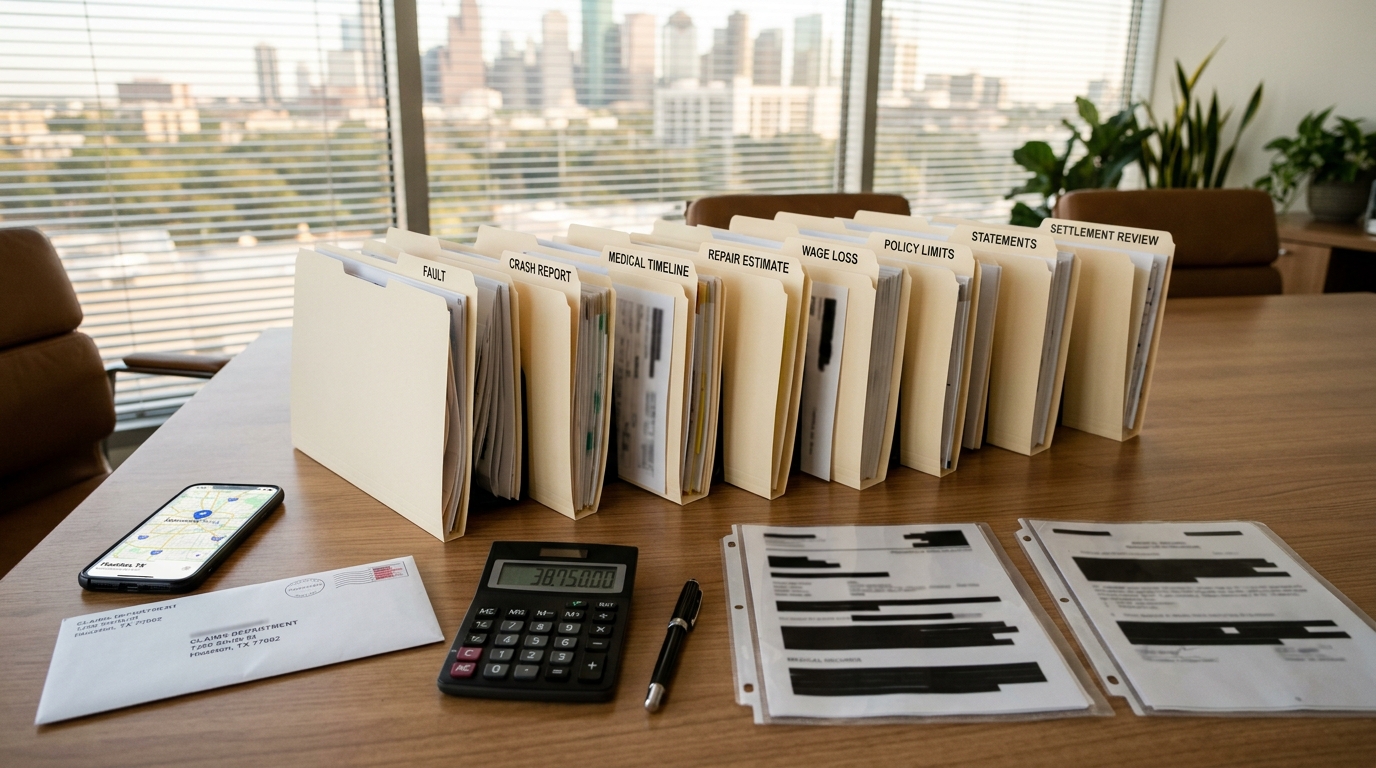
After a Houston car accident, the insurance company is not just collecting paperwork. It is building an internal review file. That file may influence whether the insurer accepts fault, questions injuries, disputes medical treatment, challenges wage loss, delays payment, offers less than expected, or asks you to sign a release.
To the injured person, the claim may feel personal. To the insurer, it may look like a series of review folders: fault, records, treatment, damage, coverage, statements, and settlement risk.
This guide explains how insurance companies may evaluate car accident claims in Houston, what records may matter, what disputes often arise, and when legal guidance may be useful.
Quick Answer
Insurance companies evaluate Houston car accident claims by reviewing fault, crash reports, photos, videos, witness statements, medical records, treatment timelines, medical bills, vehicle damage, repair estimates, lost wages, prior injuries, recorded statements, policy limits, available coverage, and settlement risk.
If you were injured in a Houston crash and the insurer is disputing fault, questioning your treatment, delaying payment, asking for a recorded statement, or making a low settlement offer, speaking with a car accident lawyer Houston residents can contact may help you understand what evidence matters and what Texas deadlines may apply.
Key Takeaways
- Insurance companies usually evaluate claims by reviewing liability, medical proof, damages, coverage, consistency, and risk.
- A strong Houston car accident claim is supported by timely medical care, clear photos, crash report information, repair records, witness details, wage proof, and organized insurance communication.
- Adjusters may dispute claims based on shared fault, treatment gaps, low visible vehicle damage, missing witnesses, prior injuries, inconsistent statements, or policy limits.
- Houston crash settings such as freeways, frontage roads, downtown intersections, parking lots, rideshare areas, and construction zones can shape the evidence file.
- Texas law can affect insurance timing, settlement strategy, and shared-fault disputes.
Inside the Adjuster Review Room
An adjuster may look at a claim through several internal questions:
- What happened?
- Who was at fault?
- What evidence supports fault?
- Was there a crash report?
- Are there photos or videos?
- Are there independent witnesses?
- Did the injured person get medical care quickly?
- Do the medical records connect the injuries to the crash?
- Were there treatment gaps?
- Are the bills related and reasonable?
- Did the injured person miss work?
- Is future care expected?
- Is there prior injury history?
- What does the vehicle damage show?
- What coverage is available?
- Are policy limits a problem?
- Did the injured person give a recorded statement?
- Would a jury likely believe the claim?
- What might happen if the case does not settle?
A claim becomes stronger when the records answer these questions clearly.
Folder 1: Fault and Responsibility
The first folder is usually fault. Before the insurer evaluates how much a claim may be worth, it may review whether its insured caused the crash.
The insurer may examine:
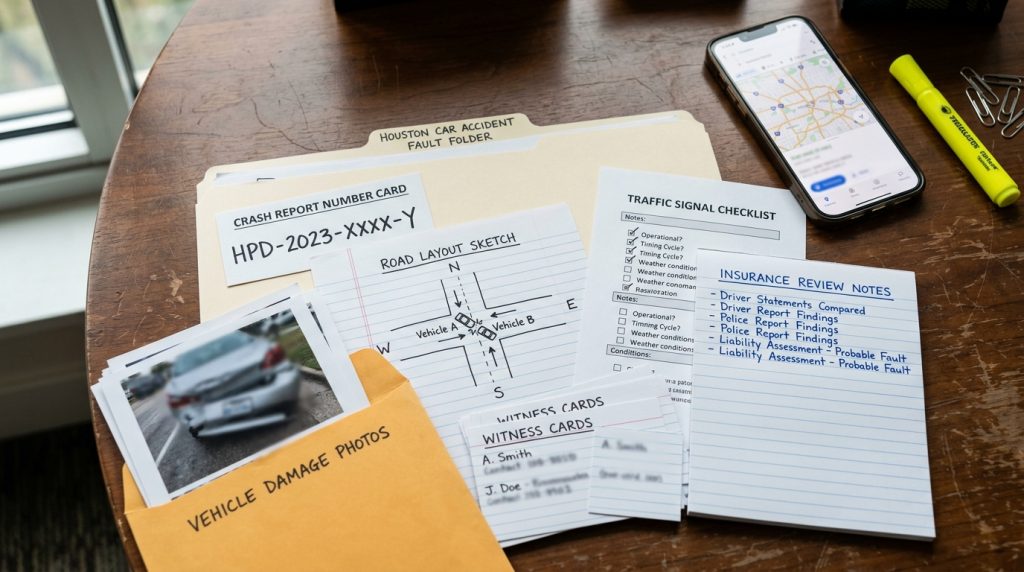
- Crash report details
- Driver statements
- Passenger statements
- Witness statements
- Scene photos
- Vehicle damage
- Traffic signals
- Stop signs
- Lane markings
- Dashcam footage
- Surveillance footage
- Citation information
- Weather and lighting
- Road layout
- Prior or later statements
In Houston, fault disputes may arise after freeway merging crashes, rear-end impacts with multiple vehicles, red-light crashes, lane-change collisions, rideshare crashes, commercial vehicle accidents, parking-lot impacts, and hit-and-run claims.
Texas shared-fault rules matter because an insurer may argue that the injured person is partly responsible.
Folder 2: Houston Crash Reports and Official Records
A crash report can help an insurer understand the accident date, time, location, parties, vehicles, insurance information, reported injuries, witness details, citations, contributing factors, and officer observations.
For Texas crashes, TxDOT is the custodian of crash records and collects crash reports from law enforcement agencies for crashes on public roadways and the state highway system. A Texas Peace Officer’s Crash Report may be available through the TxDOT Crash Report Online Purchase System.
For Houston crashes, the Houston Police Department describes an accident or crash report as a Texas Peace Officers’ Accident Report completed by a Houston police officer and filed with TxDOT.
Save:
- Crash report number
- Responding agency
- Officer name, if known
- Crash date
- Crash time
- Crash location
- Driver and vehicle details
- Insurance information
- Witness details
- Citation information, if any
A crash report can help, but it is not the entire claim. Photos, video, witness details, medical records, repair estimates, and insurance messages may also be important.
Folder 3: Medical Treatment Timeline
Insurance companies pay close attention to when medical care began and whether treatment was consistent.
They may ask:
- Did the injured person seek care the same day?
- Was there an emergency room visit?
- Was urgent care needed?
- Were symptoms reported clearly?
- Did the person follow up with recommended care?
- Were there gaps in treatment?
- Did the person miss appointments?
- Did symptoms change over time?
- Did the records mention the crash?
- Were future treatment needs documented?
Treatment gaps can create disputes. The insurer may argue that the injuries were not serious, were not related to the crash, or were caused by something else.
Save records from:
- Emergency medical services
- Emergency rooms
- Urgent care clinics
- Primary care doctors
- Orthopedic specialists
- Neurologists
- Imaging centers
- Physical therapy providers
- Pharmacies
Also save:
- Medical bills
- Prescription receipts
- Imaging reports
- Discharge instructions
- Referral paperwork
- Work restriction notes
- Therapy attendance records
- Follow-up appointment summaries
Folder 4: Medical Bills, Causation, and Future Care
Medical bills are important, but insurers may not accept every number at face value.
An adjuster may review:
- Diagnoses
- Treatment dates
- Provider notes
- Whether treatment relates to the crash
- Whether treatment appears necessary
- Whether treatment was consistent
- Whether bills appear reasonable
- Whether there were prior similar injuries
- Whether PIP, MedPay, health insurance, or UM/UIM coverage may apply
- Whether future care is supported by medical records
Future treatment can be especially important. A settlement offer made before treatment is complete may not reflect surgery recommendations, long-term therapy, permanent impairment, or symptoms that worsen later.
Folder 5: Vehicle Damage and Repair Records
Insurance companies often compare injury claims with vehicle damage. They may argue that low visible damage means a minor injury. That argument is not always fair, but it is common.
Save:
- Vehicle damage photos
- Repair estimates
- Supplemental repair estimates
- Body shop invoices
- Total-loss valuation paperwork
- Rental receipts
- Towing receipts
- Storage bills
- Photos of damaged personal property
- Communications with repair shops
- Communications with insurers
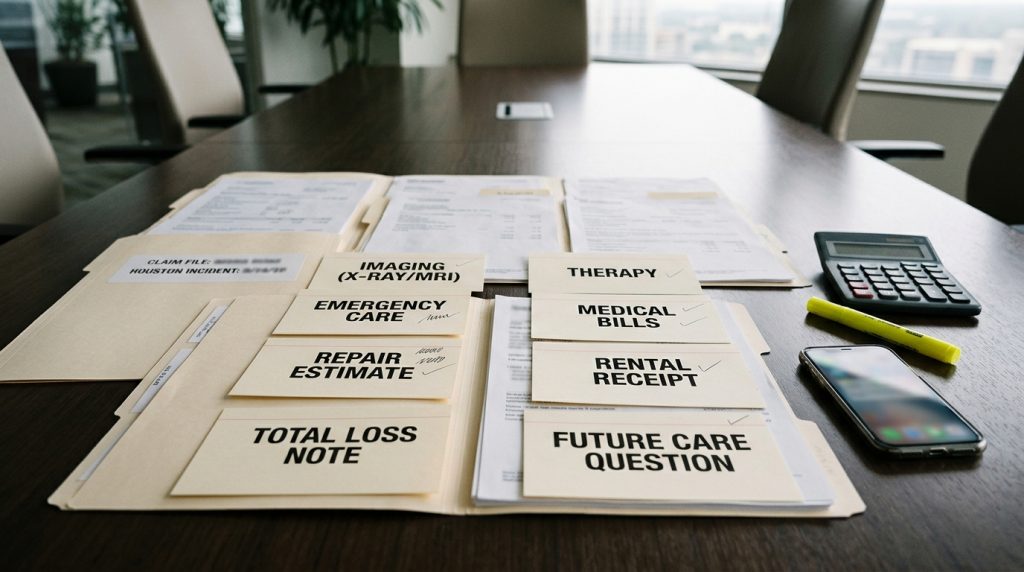
The repair file may show impact points, hidden damage, supplemental repairs, total-loss issues, and rental timing.
If the vehicle is totaled, keep valuation documents and ask how the insurer calculated the actual cash value.
Folder 6: Lost Wages and Daily-Life Impact
Insurance companies usually require proof before considering lost income.
Useful wage records may include:
- Pay stubs
- Timesheets
- Employer letters
- Missed-shift confirmations
- Work restriction notes
- Tax records
- Contractor invoices
- Business income records
- Schedule changes
- Reduced-duty notes
- Proof of used sick time or vacation time
If the injury affects future earning ability, more documentation may be needed. That may include medical restrictions, job descriptions, income history, employer statements, and evidence showing how the injury limits work duties.
A short recovery journal can also help document daily-life impact. Keep it factual. Track pain levels, sleep problems, mobility limits, headaches, driving difficulty, missed activities, medication side effects, and changes to work or family responsibilities.
Folder 7: Available Coverage and Policy Limits
A claim may be worth more than the insurance available. Policy limits can affect settlement strategy.
Insurance companies may review:
- At-fault driver liability limits
- Commercial insurance, if a company vehicle was involved
- Rideshare coverage, if applicable
- Uninsured motorist coverage
- Underinsured motorist coverage
- Personal injury protection
- Medical payments coverage
- Collision coverage
- Rental coverage
- Health insurance and lien issues
Texas auto policies may include PIP unless rejected in writing, and insurers must offer UM/UIM coverage. UM/UIM can matter when the at-fault driver has no insurance, not enough insurance, or leaves the scene.
If the other driver’s limits are too low, your own coverage may become important.
Folder 8: Statements, Consistency, and Credibility
Insurance companies review consistency. They may compare crash reports, medical records, recorded statements, claim forms, repair notes, social media posts, and earlier statements.
Be careful with:
- Recorded statements
- Broad medical authorizations
- Quick settlement calls
- Social media posts
- Text messages about the crash
- Casual comments to adjusters
- Guessing about facts you do not know
Avoid guessing about speed, distance, timing, fault, visibility, injury severity, or future medical needs. If you do not know something, say you do not know.
A short answer is often safer than a guess.
Folder 9: Settlement Authority and Release Risk
A settlement offer is not just a number. It is usually tied to a release.
Before signing, ask:
- Are all medical bills included?
- Is future care expected?
- Are lost wages included?
- Are repair or rental issues separate?
- Are health insurance liens or reimbursement claims possible?
- Does the release include all claims?
- Does it release only one party or multiple parties?
- Does it include unknown injuries?
- Is the payment final?
- Are you still treating?
The insurance company may ask you to sign a release promising that you will not file more claims from the accident. That is why future medical needs should be considered before signing.

Common Reasons Insurers Reduce or Deny Claims
Insurance companies may reduce or deny claims for many reasons.
Common arguments include:
- Their driver was not at fault
- You were partly at fault
- There is not enough evidence
- Injuries were not caused by the crash
- Medical care was delayed
- Treatment was inconsistent
- Bills were too high
- Treatment was unnecessary
- Injuries were pre-existing
- Vehicle damage was minor
- Witnesses are missing
- Statements are inconsistent
- Policy limits are low
- Coverage does not apply
- A release was already signed
A strong claim file anticipates these arguments and answers them with records.
Houston Crash Context That May Affect Evaluation
Houston car accident claims may involve:
- I-45
- I-10
- I-69/US 59
- Loop 610
- Beltway 8
- US 290
- SH 288
- Hardy Toll Road
- Westpark Tollway
- Grand Parkway
- Downtown intersections
- Galleria-area traffic
- Texas Medical Center traffic
- Midtown and Montrose corridors
- Westheimer and Richmond traffic
- Construction zones
- Flood-prone streets
- Retail parking lots
- Apartment entrances
- Rideshare and delivery traffic
- Commercial vehicle routes
The accident setting affects the evidence. A freeway crash may depend on lane-change details, dashcam footage, and tow records. A downtown crash may involve business cameras and pedestrian witnesses. A parking-lot crash may require property camera footage and vehicle-position photos.
Houston Vision Zero materials describe the city’s commitment to ending traffic deaths and serious injuries by 2030. That local safety context does not prove fault in a specific claim, but it reinforces why crash location, road design, lighting, speed, intersections, and vulnerable road users may matter.
How Texas Insurance Timing May Affect the Claim
Texas law sets certain deadlines for insurance companies after a claim is filed with your own insurer. The Texas Department of Insurance explains that a company generally must acknowledge a claim within 15 days of receiving notice, may request more information, must accept or reject the claim within 15 business days after receiving all needed information, must explain certain delays, and must send payment within five business days after agreeing to pay.
The same TDI guidance notes that the prompt-payment law does not apply when another driver’s insurance company is paying the claim. However, that company must act in good faith and try to settle quickly and fairly.
This distinction matters. A claim with your own insurer may have one set of timing rules. A third-party claim against another driver’s insurer may involve different pressure points.
Texas Deadlines and Shared-Fault Rules
Texas personal injury claims are time-sensitive. In many cases, a person must bring a personal injury lawsuit within two years after the day the cause of action accrues under Texas Civil Practice and Remedies Code Section 16.003.
That does not mean you should wait. Insurance evaluations can take time, evidence may disappear, camera footage may be overwritten, and medical records may take weeks to collect.
Texas law can also affect recovery when fault is disputed. Under Texas Civil Practice and Remedies Code Section 33.001, a claimant may not recover damages if their percentage of responsibility is greater than 50%.
Because insurance companies may use fault arguments to reduce claim value, evidence is especially important.
What Records Should You Send to the Insurance Company?
Insurance companies may ask for records, but you should be thoughtful about what you send and when.
Useful records may include:
- Crash report
- Photos of the scene
- Vehicle damage photos
- Witness information
- Medical records related to the crash
- Medical bills
- Repair estimates
- Rental receipts
- Towing receipts
- Wage records
- Work restriction notes
- Out-of-pocket expense receipts
Be careful with broad medical authorizations. A broad authorization may allow an insurer to request unrelated medical history. Ask what records are needed and why.
When Legal Guidance May Be Useful
Not every car accident claim requires legal help. However, legal guidance may be useful when the insurance evaluation becomes difficult, unfair, or confusing.
Consider speaking with a lawyer if:
- You needed emergency care
- You were hospitalized
- Medical treatment is ongoing
- The insurer disputes fault
- The insurer says you were partly responsible
- The insurer questions your medical treatment
- The insurer asks for a recorded statement
- The insurer requests broad medical authorizations
- The insurer delays or denies the claim
- The settlement offer seems too low
- The at-fault driver has no insurance
- The at-fault driver has low policy limits
- A commercial vehicle or rideshare vehicle was involved
- You missed work
- Future medical care may be needed
- A loved one suffered a fatal injury
A lawyer may help organize evidence, communicate with insurers, evaluate damages, preserve records, respond to disputes, and explain Texas deadlines.
Houston Car Accident Claim Evaluation Checklist
Use this checklist to strengthen the claim file:
Fault Evidence
- Crash report number
- Scene photos
- Vehicle damage photos
- Road layout photos
- Traffic signal or sign photos
- Witness names and phone numbers
- Dashcam or nearby camera notes
Medical Evidence
- Emergency care records
- Urgent care records
- Imaging reports
- Specialist notes
- Therapy records
- Medical bills
- Prescription receipts
- Work restriction notes
- Future care recommendations
Financial Evidence
- Repair estimates
- Rental receipts
- Towing and storage records
- Pay stubs
- Timesheets
- Employer letters
- Out-of-pocket receipts
- Recovery journal notes
Insurance Evidence
- Claim numbers
- Adjuster contact information
- Insurance letters
- Policy limit information
- Recorded statement requests
- Medical authorization requests
- Settlement offers
- Denial letters
Before Signing
- Confirm treatment status
- Ask about future care
- Review medical bills
- Review wage loss
- Review repair and rental issues
- Ask about liens or reimbursement claims
- Understand what the release covers
- Ask about Texas deadlines
FAQ
How do insurance companies evaluate car accident claims?
They review fault, crash reports, photos, videos, witness statements, medical records, treatment timelines, medical bills, vehicle damage, wage loss, policy limits, prior injuries, statements, and settlement risk.
Why does the insurance company care when I first got medical treatment?
The insurer may use the treatment timeline to decide whether the injuries appear related to the crash. Delayed care or treatment gaps can create disputes.
Do medical bills automatically determine settlement value?
No. Medical bills are important, but insurers may also review treatment necessity, causation, injury severity, policy limits, wage loss, future care, and fault.
Can an insurance company use my recorded statement against me?
A recorded statement may be compared to other records. Guessing about speed, distance, timing, injuries, or fault can create problems later.
What if the insurance company says I was partly at fault?
Texas proportionate responsibility rules can reduce or prevent recovery depending on the percentage of fault. Evidence such as photos, witnesses, crash reports, and video can become important.
Why does vehicle damage matter in an injury claim?
Insurers often compare claimed injuries with vehicle damage. Repair estimates, photos, supplemental damage records, and medical documentation may help explain the full impact of the crash.
Should I sign a medical authorization?
Be careful with broad medical authorizations. Ask what records are needed and whether the request is limited to treatment related to the accident.
Why is the settlement release important?
A release usually ends the claim. Before signing, consider medical bills, future care, lost wages, liens, property damage, and whether treatment is complete.
How long does an insurance company have to respond in Texas?
For many first-party claims with your own insurer, Texas law sets deadlines for acknowledgment, investigation, acceptance or rejection, and payment. Third-party claims against another driver’s insurer may follow different rules.
What if the other driver’s insurance limits are too low?
Your own uninsured/underinsured motorist coverage, PIP, medical payments coverage, health insurance, or other coverage may need to be reviewed.
Is this article legal advice?
No. This article is for general informational purposes only. Anyone dealing with a specific car accident claim should speak with a qualified legal professional about their situation.
Final Thoughts
Insurance companies evaluate Houston car accident claims by looking for proof. They review fault, crash records, medical care, treatment timing, repair records, wage loss, policy limits, statements, and settlement risk.
The best way to protect yourself is to stay organized. Save records, keep communication factual, follow medical advice, track expenses, avoid signing releases too early, and ask questions before important deadlines pass.