

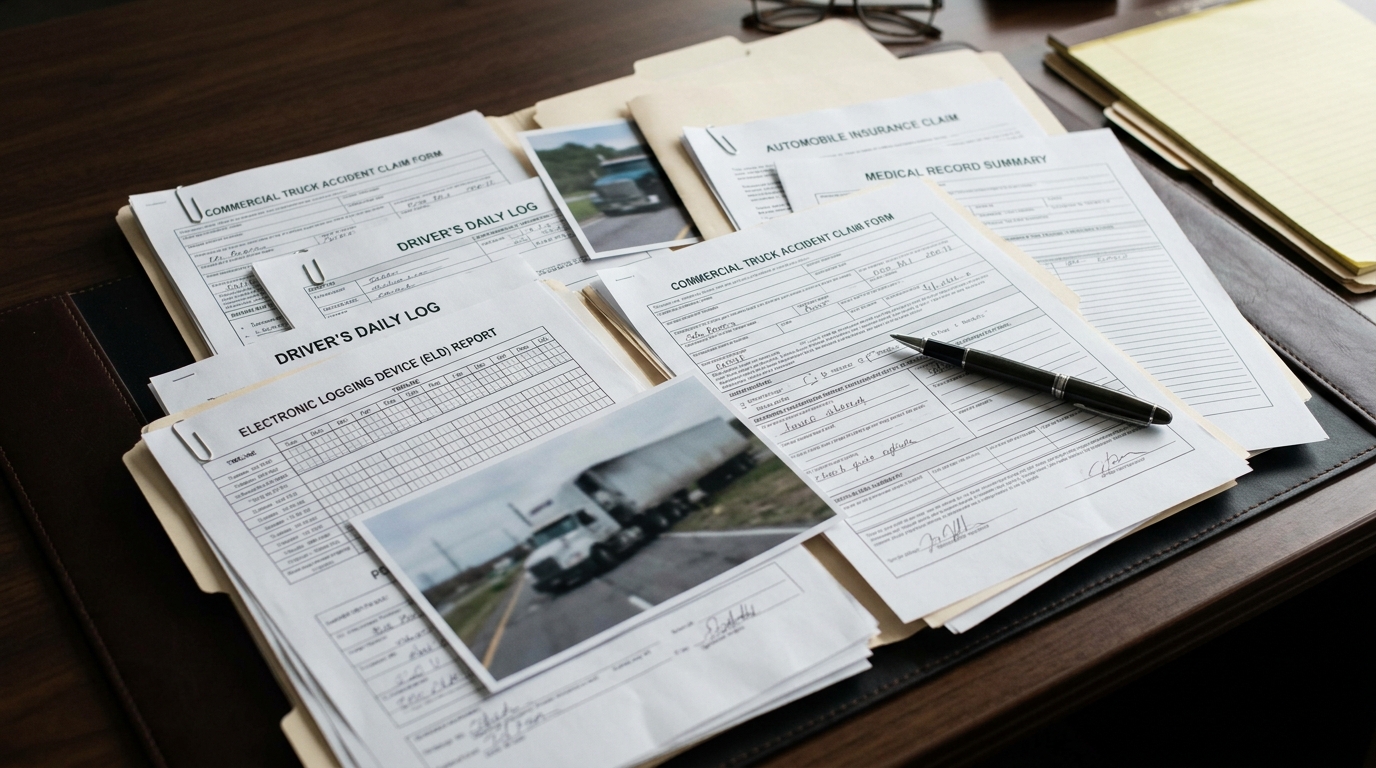
Truck driver logs and hours-of-service evidence can be important in New York truck accident claims because they may show whether a commercial driver was fatigued, over hours, under pressure, or operating outside safety rules before a crash. These records may also reveal inconsistencies between a driver’s statements, electronic logs, dispatch records, GPS data, delivery schedules, fuel receipts, and inspection records. A truck accident attorney resource can help explain how commercial vehicle evidence, insurance coverage, medical records, and liability are generally evaluated after a truck crash.
Quick Answer
Truck driver logs and hours-of-service evidence can help show whether fatigue, excessive driving time, false log entries, dispatch pressure, missed rest breaks, or carrier oversight contributed to a New York truck accident. Important records may include electronic logging device data, records of duty status, supporting documents, dispatch records, GPS data, toll records, fuel receipts, bills of lading, delivery schedules, inspection records, accident registers, and driver qualification materials. These records should be preserved early because some federal recordkeeping periods are limited.
Key Takeaways
- Hours-of-service rules limit how long many commercial drivers may drive and remain on duty.
- FMCSA summarizes core property-carrying driver rules, including an 11-hour driving limit after 10 consecutive hours off duty, a 14-hour driving window, a 30-minute break requirement after 8 cumulative hours of driving without a qualifying interruption, and 60/70-hour limits over 7/8 consecutive days. FMCSA
- Electronic logging devices, or ELDs, are used by many commercial drivers who are required to keep records of duty status. FMCSA explains that the ELD rule applies to most motor carriers and drivers required to keep those records. FMCSA
- FMCSA states that motor carriers must retain records of duty status and supporting documents for six months. FMCSA
- FMCSA safety materials state that motor carriers must maintain an accident register for crashes meeting the regulatory definition for the past three years. FMCSA CSA
- New York no-fault written notice generally must be provided as soon as reasonably practicable, but no more than 30 days after the accident unless a clear and reasonable justification exists. Department of Financial Services
- Truck accident claims can involve the driver, carrier, vehicle owner, freight broker, shipper, maintenance provider, loading company, or another driver depending on the facts.
What Are Truck Driver Logs?
Truck driver logs are records that show a commercial driver’s work, driving, rest, and off-duty time. These records are often called records of duty status, or RODS. They help show whether the driver complied with hours-of-service rules before a crash.
Driver logs may show:
- Driving time
- On-duty time
- Off-duty time
- Sleeper berth time
- Start and end of shifts
- Breaks
- Route activity
- Location data
- Vehicle movement
- Certification or edits
- Driver identification
- Truck and trailer information
- Carrier information
- Shipping information
In a truck accident claim, the logs may help answer whether the driver had enough rest, whether the driver exceeded legal driving limits, and whether the carrier allowed or encouraged unsafe scheduling.
What Are Hours-of-Service Rules?
Hours-of-service rules are federal safety rules that limit how long many commercial drivers can drive and work before taking rest. The purpose is to reduce fatigue-related driving risk. FMCSA summarizes property-carrying driver rules to include an 11-hour driving limit after 10 consecutive hours off duty, a 14-hour driving window, a 30-minute break requirement after 8 cumulative hours of driving without a qualifying interruption, and 60/70-hour limits over 7/8 consecutive days. FMCSA
Hours-of-service evidence may help determine whether:
- The driver exceeded driving limits.
- The driver worked too many hours.
- The driver skipped required rest.
- The driver drove after a long on-duty period.
- The carrier’s schedule was unrealistic.
- Dispatch pressure contributed to unsafe driving.
- Logs were edited or inaccurate.
- Supporting documents match the log entries.
A violation does not automatically prove the entire injury claim, but it may become important evidence of unsafe conduct.
Why Hours-of-Service Evidence Matters in Truck Accident Claims
Truck accidents often involve serious injuries because commercial vehicles are large, heavy, and difficult to stop quickly. If fatigue, long hours, or unsafe dispatch pressure contributed to the crash, driver logs may become central evidence.
Hours-of-service evidence may help explain:
- Driver fatigue
- Delayed reaction time
- Failure to brake
- Lane departure
- Rear-end collisions
- Unsafe speed
- Failure to notice stopped traffic
- Loss of control
- Inconsistent driver statements
- Carrier scheduling practices
- Whether a company ignored safety rules
A broader guide to evidence for personal injury claims can help explain why logs, records, photos, medical documentation, and witness information often need to support the same timeline.
Electronic Logging Devices
An electronic logging device records driving and duty status information for many commercial drivers. FMCSA explains that the ELD rule is intended to help accurately track, manage, and share records of duty status data. FMCSA
ELD records may show:
- Log-in and log-out activity
- Driving time
- On-duty time
- Off-duty time
- Sleeper berth time
- Location changes
- Engine power status
- Vehicle motion status
- Miles driven
- Edits and annotations
- Unassigned driving time
- Certification of logs
- Data transfer records
- Malfunction events
ELD data can be useful because it may be more detailed than a driver’s handwritten recollection. However, the data still needs to be reviewed with supporting documents because ELD records can involve edits, annotations, unidentified driving, exemptions, or device issues.
Records of Duty Status
Records of duty status are the formal driver logs used to show the driver’s work and rest activity. FMCSA materials explain that drivers who are required to keep these records may be subject to ELD requirements, and records of duty status are central to hours-of-service compliance. FMCSA
A record of duty status may identify:
- Driver name
- Motor carrier
- Date
- Truck or tractor number
- Trailer number
- Main office address
- Shipping document number
- Duty status changes
- Total miles driven
- Total hours
- Driver certification
- Remarks or annotations
In a truck crash claim, these records may be compared with GPS data, toll records, fuel receipts, dispatch messages, bills of lading, and delivery schedules.
Supporting Documents
Supporting documents are records that help verify a driver’s logs. FMCSA explains that supporting documents are used to verify records of duty status and identifies categories such as bills of lading, dispatch records, expense receipts, electronic mobile communication records, payroll records, and settlement sheets.
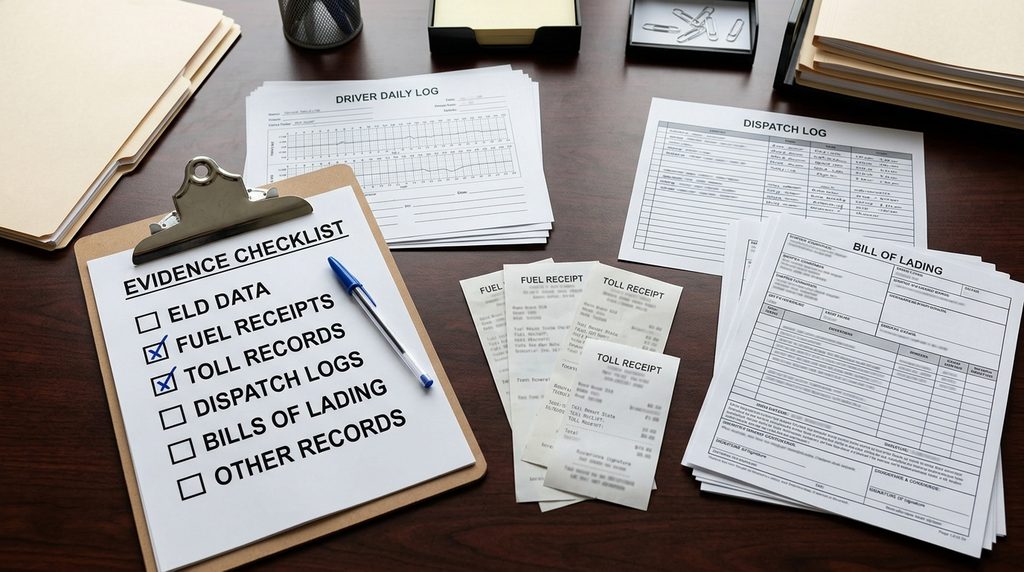
Supporting documents may include:
- Bills of lading
- Dispatch records
- Trip sheets
- Fuel receipts
- Toll records
- Scale tickets
- Weight tickets
- Delivery receipts
- Loading records
- Electronic messages
- GPS records
- Mobile communication records
- Payroll records
- Settlement sheets
- Repair receipts
- Inspection records
- Hotel receipts
These records may reveal whether the driver’s log matches real-world movements, stops, loads, and deliveries.
Why Record Preservation Is Urgent
Truck accident evidence should be preserved quickly because some records are kept for limited periods. FMCSA states that motor carriers must retain records of duty status and supporting documents for six months from the date of receipt. FMCSA
This matters because critical records may include:
- ELD data
- Supporting documents
- Dispatch communications
- GPS records
- Delivery logs
- Toll receipts
- Fuel receipts
- Driver messages
- Inspection records
- Maintenance records
- Accident register entries
- Dashcam footage
- In-cab camera footage
Early preservation letters can help prevent records from being lost, overwritten, deleted, or routinely discarded.
Driver Fatigue and Truck Accidents
Driver fatigue can affect reaction time, attention, judgment, lane control, and decision-making. Fatigue may be involved even if the driver did not fall asleep. Long hours, irregular schedules, overnight driving, loading delays, delivery pressure, and insufficient rest can all affect driver performance.
Fatigue-related crash clues may include:
- No braking before impact
- Lane drift
- Rear-end impact
- Running off the road
- Failure to react to traffic
- Inconsistent driver statements
- Crash during late-night or early-morning hours
- Long trip before crash
- Missed rest break
- Unrealistic delivery schedule
- Prior hours-of-service issues
Driver logs can help show whether fatigue was a reasonable concern before the crash.
Log Violations Do Not Automatically Prove the Whole Claim
A log violation may be important, but it does not automatically prove every part of a truck accident claim. The injured person still needs evidence showing how the violation relates to the crash and how the crash caused injuries and damages.
A claim may still need proof of:
- Fault
- Crash sequence
- Medical causation
- Injury severity
- Future care
- Lost income
- Pain and suffering
- Insurance coverage
- Policy limits
- Comparative fault
- Carrier responsibility
For example, a driver may have a log issue that is unrelated to the crash. In another case, an hours-of-service violation may directly support a fatigue theory. The facts determine the value of the evidence.
What Truck Logs May Reveal
Truck logs can help identify patterns that may not appear in a police report. A crash report may show what happened at the scene, but logs may show what happened in the hours or days before the crash.
Truck logs may reveal:
- Excess driving time
- Excess on-duty time
- Missed rest periods
- False off-duty entries
- Unassigned driving time
- Log edits after the crash
- Uncertified logs
- Repeated HOS violations
- Long delays at loading docks
- Tight delivery windows
- Driver fatigue risk
- Carrier pressure
- Dispatch conflicts
- Route inconsistencies
- Gaps in data
These details can affect liability, settlement negotiations, and litigation strategy.
Comparing Logs With Other Records
Driver logs are most useful when compared with other records. A log may say the driver was off duty, while fuel receipts, toll records, GPS data, or delivery records show activity during that same period.
Records that may be compared include:
- ELD data
- GPS data
- Fuel receipts
- Toll records
- Weigh station records
- Scale tickets
- Dispatch messages
- Bills of lading
- Delivery confirmations
- Cell phone records
- Maintenance records
- Inspection reports
- Dashcam footage
- Surveillance footage
- Police reports
- Driver statements
When records do not match, the inconsistency may suggest log inaccuracies or missing evidence.
Dispatch Records and Delivery Pressure
Dispatch records may show whether the motor carrier placed pressure on the driver to meet a schedule that was difficult or unsafe. A driver may technically control the vehicle, but the carrier’s scheduling practices may still matter.

Dispatch evidence may show:
- Pickup deadlines
- Delivery deadlines
- Route instructions
- Driver messages
- Load assignments
- Delay communications
- Pressure to continue driving
- Missed rest opportunities
- Last-minute route changes
- Delivery penalties
- Customer demands
- Broker or shipper communications
A claim may need to evaluate whether the crash was caused only by driver error or also by company practices.
GPS and Telematics Data
Many commercial vehicles use GPS and telematics systems. These records may help reconstruct the driver’s route and activity before the crash.
GPS and telematics records may show:
- Vehicle location
- Speed
- Route
- Stops
- Idle time
- Harsh braking
- Rapid acceleration
- Lane movement, depending on system
- Engine data
- Travel time
- Delivery route
- Driver behavior alerts
- Fleet safety alerts
These records can be especially useful when the driver’s statement conflicts with the physical evidence.
Dashcam and In-Cab Video
Truck cameras may capture the road ahead, driver behavior, or both. Video can become important when fatigue, distraction, lane drift, or failure to brake is disputed.
Video evidence may show:
- Traffic conditions
- Roadway conditions
- Braking behavior
- Lane position
- Driver eye movement
- Driver head position
- Phone use
- Signs of drowsiness
- Weather
- Impact sequence
- Vehicle speed indicators, depending on system
- Other vehicles
Video may be overwritten quickly. Preservation should be addressed as early as possible.
Accident Register Evidence
FMCSA safety materials state that motor carriers must maintain a register of crashes meeting the regulatory definition for the past three years. FMCSA CSA
Accident register evidence may help identify:
- Prior crashes
- Crash patterns
- Driver safety history
- Carrier safety practices
- Injury crashes
- Towed vehicle crashes
- Fatal crashes
- Dates and locations of prior incidents
- Whether the same driver had prior crashes
- Whether the carrier had recurring safety issues
Prior crashes do not automatically prove liability in a new claim, but they may help evaluate safety practices and discovery needs.
Driver Qualification File Evidence
A truck driver’s qualification file may help show whether the motor carrier properly evaluated the driver before allowing them to operate a commercial vehicle.
Driver qualification evidence may include:
- Driver application
- Commercial driver’s license information
- Motor vehicle record
- Prior employment inquiries
- Road test or equivalent documentation
- Medical certification
- Safety performance history
- Training records
- Drug and alcohol testing context, when relevant
- Driver discipline records
- Prior violations
A qualification file may matter when the claim involves driver inexperience, prior safety problems, or negligent hiring arguments.
Vehicle Inspection and Maintenance Records
Hours-of-service evidence may show fatigue, but inspection and maintenance records may show whether the truck was safe to operate. Both categories can matter in the same case.
Maintenance evidence may include:
- Driver vehicle inspection reports
- Brake inspection records
- Tire records
- Repair orders
- Preventive maintenance logs
- Out-of-service records
- Annual inspection reports
- Post-crash inspection records
- Fleet maintenance software records
- Mechanic notes
- Parts replacement records
A crash may involve both driver fatigue and equipment issues, especially when braking, tires, lights, or steering are disputed.
Loading, Shipping, and Cargo Records
Truck crashes may involve cargo problems, weight issues, shifting loads, or unrealistic delivery schedules. Shipping records can help connect driver logs with the movement of the load.
Useful cargo-related records may include:
- Bills of lading
- Load confirmation sheets
- Weight tickets
- Scale tickets
- Delivery receipts
- Loading dock records
- Seal records
- Cargo securement records
- Shipper communications
- Broker communications
- Trailer interchange documents
- Warehouse entry and exit records
Cargo records may show where the driver was, how long loading took, whether the truck was overweight, and whether delays affected the driver’s schedule.
Phone Records and Driver Communications
Phone records and messaging records may matter if distraction, dispatch pressure, or timeline disputes are involved. These records may show communication shortly before the crash.
Relevant communications may include:
- Calls with dispatch
- Text messages
- App messages
- Fleet communication messages
- Delivery instructions
- Customer messages
- Broker messages
- Navigation entries
- Driver emails
- Hands-free system logs
Phone records may not tell the full story by themselves, but they can help confirm timing and communication patterns.
Truck Logs in Rear-End Collision Claims
Truck driver logs can be important in rear-end crashes because fatigue may affect reaction time. A commercial driver who fails to slow for stopped traffic may have been distracted, fatigued, driving too fast, following too closely, or affected by equipment problems.
Important evidence may include:
- ELD data
- Brake data
- Dashcam footage
- Driver logs
- Prior duty time
- Dispatch schedule
- Vehicle speed
- Following distance
- Weather conditions
- Maintenance records
- Driver statements
- Witness statements
A rear-end crash involving a truck should usually review both the crash scene and the hours before the crash.
Truck Logs in Multi-Vehicle Accidents
Multi-vehicle truck crashes can involve complex fault allocation. Driver logs may show whether the truck driver was fatigued, but the claim may also involve other drivers, roadway hazards, weather, or commercial vehicle maintenance.
Useful evidence may include:
- Crash sequence diagrams
- Vehicle damage photos
- ELD data
- GPS data
- Dashcam footage
- Witness statements
- Police report
- Accident reconstruction
- Dispatch records
- Other vehicle insurance information
- Medical records
A broader guide to multiple defendant injury claims can help explain why identifying every responsible party matters when more than one driver or business may have contributed to a crash.
Truck Logs and Construction Zone Crashes
Construction zones can create narrow lanes, sudden stops, lane shifts, merging traffic, and reduced visibility. Driver logs may be important if a truck driver entered a work zone while fatigued or over hours.
Construction zone evidence may include:
- ELD data
- Road work records
- Traffic control plans
- Warning signs
- Dashcam footage
- Driver logs
- Vehicle speed
- Lane closure records
- Contractor records
- Police report
- Witness statements
These claims may involve both commercial vehicle evidence and roadway or contractor evidence.
Truck Logs and Pedestrian, Bicycle, or Motorcycle Crashes
Truck crashes involving pedestrians, bicyclists, or motorcyclists can be severe. Driver logs may matter when fatigue, inattention, or delayed reaction contributed to the crash.
Important evidence may include:
- ELD data
- Driver duty time
- Route data
- Turn records
- Blind spot issues
- Dashcam footage
- GPS data
- Witness statements
- Driver statements
- Traffic signal evidence
- Medical records
A fatigued driver may be less able to detect vulnerable road users, react to hazards, or avoid a collision.
No-Fault Benefits After a Truck Accident
New York no-fault benefits may apply after many motor vehicle accidents and may cover certain economic losses such as medical expenses, lost earnings, and reasonable accident-related expenses. Written no-fault notice generally must be provided as soon as reasonably practicable, but no more than 30 days after the accident unless there is a clear and reasonable justification for late notice. Department of Financial Services
No-fault benefits may cover:
- Emergency treatment
- Hospital bills
- Doctor visits
- Diagnostic testing
- Physical therapy
- Chiropractic care
- Prescription medication
- Lost earnings
- Transportation to medical care
- Certain other reasonable and necessary expenses
A no-fault claim is separate from the liability claim against a truck driver, carrier, or other responsible party.
Serious Injury and Truck Accident Damages
In many New York motor vehicle claims, pain and suffering recovery requires proof of serious injury under New York Insurance Law. Truck crashes often involve serious injuries, but the claim still needs medical evidence.
Serious injury evidence may include:
- Fracture records
- MRI reports
- CT scans
- Surgery records
- Specialist reports
- Range-of-motion testing
- Physical therapy records
- Permanent limitation opinions
- Significant limitation documentation
- Scarring photos
- Work restriction notes
- Future care recommendations
Logs and hours-of-service evidence may support fault. Medical records support injuries, damages, and causation.
Common Injuries in Truck Accident Claims
Truck accidents can cause severe injuries because of vehicle size, weight, speed, and impact force.
Common injuries may include:
- Head injuries
- Concussions
- Neck injuries
- Back injuries
- Disc injuries
- Spinal cord injuries
- Fractures
- Shoulder injuries
- Knee injuries
- Hip injuries
- Internal injuries
- Chest injuries
- Facial injuries
- Burns
- Nerve damage
- Psychological trauma
- Wrongful death
The medical timeline should clearly connect the crash, diagnosis, treatment, restrictions, and long-term effects.
Comparative Fault in Truck Accident Claims
Comparative fault can still be raised in a truck accident claim. New York CPLR § 1411 generally allows damages to be reduced in proportion to the claimant’s share of fault, subject to specific rules. New York Courts
Comparative fault arguments may involve:
- Speeding
- Unsafe lane changes
- Sudden braking
- Following too closely
- Failure to yield
- Driving too fast for weather
- Distracted driving
- Poor visibility
- Road hazard response
- Motorcycle or bicycle positioning
- Pedestrian crossing conduct
A truck driver log issue may support the claim, but fault allocation still depends on the full evidence.
Insurance Coverage in Truck Accident Claims
Truck accident claims may involve several insurance policies and business entities. The truck driver may not be the only responsible party.
Insurance and liability review may involve:
- Truck driver liability
- Motor carrier liability
- Vehicle owner coverage
- Trailer owner coverage
- Shipper or broker involvement
- Maintenance provider responsibility
- Loading company responsibility
- Commercial auto policies
- Excess policies
- Umbrella policies
- Self-insured retention
- Multiple injured people
- Policy limit issues
A complete insurance review should identify all potentially responsible businesses and coverage layers before settlement.
Policy Limits and Commercial Coverage
Truck accident claims may involve higher policy limits than standard auto claims, but higher coverage is not automatic. Coverage depends on the vehicle, carrier, cargo, route, policy terms, and responsible parties.
Policy limit review may include:
- Commercial auto policy limits
- Excess coverage
- Umbrella coverage
- Motor carrier coverage
- Trailer coverage
- Broker or shipper coverage
- Employer coverage
- Self-insured retention
- Multiple claimant issues
- Reservation of rights letters
- Coverage exclusions
Policy limits can affect settlement strategy, especially when injuries are serious or several people were injured in the same crash.
Settlement Value in Truck Log Cases
Settlement value depends on liability, injury severity, medical proof, hours-of-service evidence, carrier responsibility, insurance coverage, future care, lost income, pain and suffering, comparative fault, and litigation risk.
Settlement factors may include:
- Driver log violations
- ELD data
- Fatigue evidence
- Dispatch pressure
- Carrier safety practices
- Crash severity
- Police report details
- Witness statements
- Video footage
- Medical diagnosis
- Treatment duration
- Surgery or injections
- Work restrictions
- Lost wages
- Future care needs
- Permanent limitations
- Policy limits
- Multiple defendants
- Liens and reimbursement claims
Publicly available personal injury case results may provide general context, but every claim depends on its own facts, evidence, injuries, insurance coverage, and applicable law.
Common Defense Arguments
Truck companies and insurers may dispute hours-of-service evidence or argue that any violation did not cause the crash.
Common arguments include:
- The driver was within legal hours.
- The log issue was minor.
- The violation was unrelated to the crash.
- The driver was not fatigued.
- The crash was caused by another driver.
- Weather caused the crash.
- The injured person was partly at fault.
- The injuries were pre-existing.
- Treatment was delayed.
- Medical records do not prove serious injury.
- The policy limits are disputed.
- The carrier was not responsible for the driver.
- The truck was leased or operated by another company.
A strong claim should connect log evidence, crash evidence, medical records, and damages in a clear timeline.

Practical Truck Log Evidence Review Chart
| Evidence Type | Why It Matters | What It May Show |
| ELD data | Tracks duty status and driving activity | Driving time, rest periods, edits, location data |
| Records of duty status | Shows official driver log history | On-duty, off-duty, driving, sleeper berth time |
| Supporting documents | Verifies whether logs match real activity | Fuel, toll, dispatch, delivery, payroll records |
| GPS and telematics | Helps reconstruct route and speed | Location, speed, stops, harsh braking |
| Dispatch records | Shows scheduling pressure and route instructions | Deadlines, messages, load assignments |
| Dashcam or in-cab video | May show crash sequence or fatigue signs | Braking, lane drift, driver behavior |
| Accident register | Shows past crash history | Prior crashes and safety patterns |
| Maintenance records | Shows vehicle condition | Brake, tire, light, steering, repair issues |
Common Mistakes After a Truck Accident
Some mistakes can make a valid truck accident claim harder to prove.
Common mistakes include:
- Not calling police
- Not seeking prompt medical care
- Not preserving photos or video
- Not collecting witness information
- Not documenting truck company details
- Not saving the truck’s license plate or USDOT number
- Missing no-fault notice deadlines
- Waiting too long to preserve ELD data
- Waiting too long to request dashcam footage
- Assuming the driver’s log is complete
- Ignoring dispatch and GPS records
- Accepting an early settlement before records are reviewed
- Not checking commercial policy limits
- Posting about the crash on social media
- Not tracking medical bills and wage loss
The strongest claims usually preserve commercial vehicle evidence as early as possible.
How to Organize a Truck Accident Claim File
A well-organized file can help explain the crash, driver hours, medical treatment, and insurance issues.
Useful folders may include:
- Police report
- DMV MV-104 report
- Scene photos
- Vehicle damage photos
- Truck and trailer photos
- USDOT number photos
- Witness information
- Dashcam footage
- Surveillance footage requests
- ELD preservation requests
- Driver log records
- Dispatch records
- GPS records
- Fuel and toll records
- Bills of lading
- Medical records
- Medical bills
- Imaging reports
- Work restriction notes
- Wage loss documents
- No-fault forms
- Insurance correspondence
- Policy documents
- Settlement offers
- Lien letters
Documents should be organized by date so the driving, crash, treatment, and insurance timeline is easier to review.
Deadlines Still Matter
Truck accident claims may involve several deadlines. These can include DMV reporting, no-fault notice, medical bill submissions, lost wage proof, insurance policy notice, evidence preservation, public entity notice, and lawsuit filing deadlines.
Important timing issues may include:
- MV-104 crash report timing
- No-fault written notice timing
- Medical bill submission timing
- Lost wage documentation
- Truck company evidence preservation
- ELD and supporting document retention
- Dashcam overwrite timing
- Insurance policy notice
- SUM notice, if applicable
- Public entity notice, if a government vehicle or roadway issue is involved
- Lawsuit filing deadlines
- Discovery deadlines
- Settlement release timing
New York DMV’s MV-104 form states that crashes involving injury, death, or more than $1,000 in property damage to any one person must be reported within 10 days. NY DMV
When Legal Guidance May Be Useful
Legal guidance may be useful when a truck accident caused serious injuries, the trucking company controls key records, fatigue is suspected, ELD data may be needed, dispatch pressure may be involved, commercial policy limits are unclear, multiple vehicles were involved, no-fault benefits are delayed, or an early settlement offer arrives before records are reviewed.
A truck accident claim review may require police reports, medical records, ELD data, records of duty status, supporting documents, dispatch communications, GPS records, bills of lading, driver qualification files, maintenance records, insurance letters, wage records, expert review, and settlement history.
People researching local support may review a Farmingdale legal office location when looking for Long Island truck accident claim information.
FAQs About Truck Driver Logs and Hours-of-Service Evidence
What are truck driver logs in an accident claim?
Truck driver logs are records showing a commercial driver’s driving time, on-duty time, off-duty time, sleeper berth time, route activity, and duty status changes. They may help show whether fatigue or hours-of-service violations contributed to a crash.
What is an electronic logging device?
An electronic logging device, or ELD, records duty status information for many commercial drivers. FMCSA explains that the ELD rule applies to most motor carriers and drivers required to keep records of duty status. FMCSA
How long are truck driver logs kept?
FMCSA states that motor carriers must retain records of duty status and supporting documents for six months from the date of receipt. Because of that limited retention period, preservation should happen quickly after a serious crash. FMCSA
Can hours-of-service violations prove a truck accident claim?
Hours-of-service violations can be important evidence, but they do not automatically prove the entire claim. The injured person still needs evidence connecting the violation to the crash and the crash to the injuries and damages.
What records can verify a truck driver’s logs?
Supporting records may include fuel receipts, toll records, GPS data, dispatch messages, bills of lading, delivery receipts, scale tickets, payroll records, mobile communication records, inspection records, and dashcam footage.
Final Thoughts
Truck driver logs and hours-of-service evidence can be critical in New York truck accident claims because they may show whether fatigue, long hours, false log entries, dispatch pressure, or unsafe carrier practices contributed to the crash. A strong claim usually depends on early preservation of ELD data, supporting documents, dispatch records, GPS data, dashcam footage, medical records, insurance letters, and wage loss proof. The key is connecting the commercial driving timeline to the crash and then connecting the crash to the injuries, damages, and available insurance coverage.