


Healthcare offices can standardize team scrub colors and styles by creating clear uniform rules for departments, roles, approved colors, fit options, embroidery, fabric, laundering, and replacement timing. A practical scrub standard helps teams look consistent while still giving staff enough size, fit, and comfort flexibility for daily clinical work.
When planning healthcare team uniforms, office managers should balance professional appearance with staff comfort, role-specific needs, workplace safety policies, and ordering logistics. The best uniform plan should be easy to explain, easy to reorder, and flexible enough for different body types, shift lengths, and job responsibilities.
Quick Answer
Healthcare offices can standardize scrub colors and styles by choosing approved colors by role or department, selecting a limited group of scrub brands or collections, offering multiple size and length options, deciding embroidery rules, and creating a clear ordering and replacement process.
A strong team uniform program should include color standards, approved scrub tops and pants, fit options, jacket or lab coat rules, group ordering procedures, backup uniform guidance, and a plan for new hires.
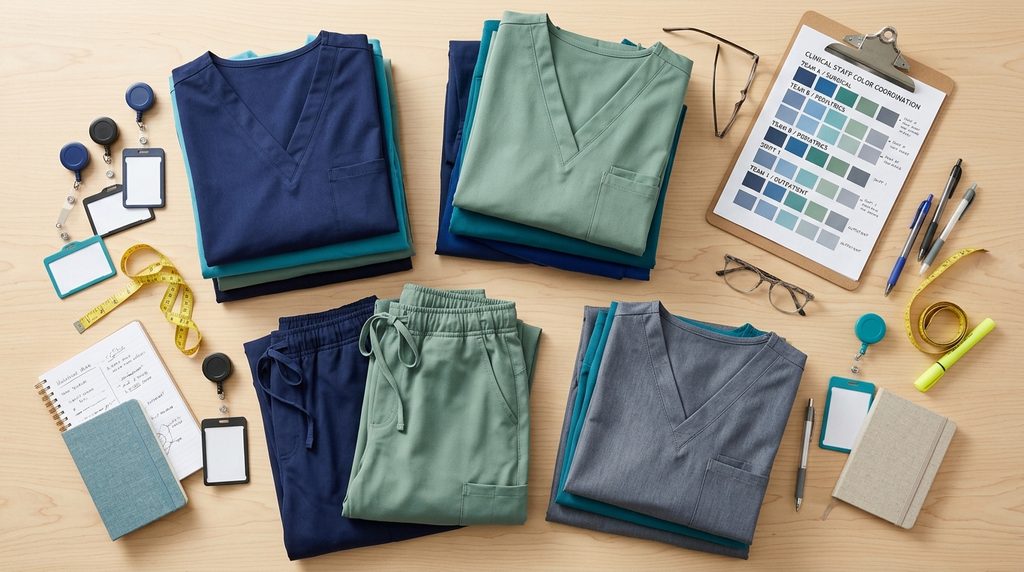
Why Team Scrub Standards Matter
A consistent scrub program helps healthcare teams present a professional and organized appearance. It can also make it easier for patients, visitors, and internal staff to recognize roles or departments. In busy offices, clinics, dental practices, veterinary settings, long-term care facilities, and outpatient centers, visual consistency can support smoother operations.
The U.S. Bureau of Labor Statistics describes healthcare occupations across many settings, including hospitals, physicians’ offices, outpatient care centers, dental offices, nursing facilities, home healthcare, and laboratories. This range of work environments helps explain why uniform standards should be tailored to the type of care setting and the team’s daily responsibilities through the broader overview of healthcare occupations.
Standardized team scrubs can help with:
- Professional first impressions
- Easier staff identification
- Cleaner department organization
- More consistent brand presentation
- Simpler new-hire onboarding
- Easier group ordering
- Better size and color consistency
- Clearer embroidery standards
- Reduced confusion about approved uniforms
- Better long-term uniform planning
The goal is not to make every staff member wear the exact same cut or fit. The goal is to create a consistent system that still works for real people doing real healthcare work.
Start With the Purpose of the Uniform Standard
Before choosing scrub colors or styles, office leaders should define why the team needs a uniform standard. The purpose affects every decision that follows.
A healthcare office may want a uniform standard to:
- Create a more professional patient-facing appearance
- Identify clinical and administrative roles
- Separate departments by color
- Make onboarding easier
- Support group ordering
- Improve staff confidence
- Align multiple office locations
- Reduce inconsistent uniform choices
- Make embroidery and logo placement consistent
- Improve team presentation for patients and visitors
A small dental office may only need one approved scrub color and one jacket option. A larger clinic may need different colors for clinical staff, front desk staff, providers, and support teams. A veterinary practice may prioritize durability and easy-care fabric. A specialty clinic may prioritize polished presentation and lab coat compatibility.
The uniform standard should match the workplace, not a generic template.
Decide Whether Colors Should Be Role-Based or Team-Wide
Color is usually the first decision in a team scrub program. Healthcare offices can either use one color for everyone or assign colors by role, department, or location.
One Color for the Whole Team
A single-color scrub standard is simple and easy to manage. It works well for small offices, dental practices, veterinary teams, private clinics, and groups that want a unified appearance.
A one-color system can help with:
- Easy reordering
- Simple staff instructions
- Consistent visual presentation
- Fewer inventory mistakes
- Easier embroidery planning
- Faster new-hire setup
The downside is that patients may not be able to visually identify roles by color. If role identification is important, a department-based color system may work better.
Colors by Department
A department-based system assigns different scrub colors to different teams. For example, clinical staff may wear one color, front office staff may wear another, and providers may wear lab coats or a separate scrub shade.
A department color system can help with:
- Staff identification
- Larger team organization
- Multi-role clinics
- Patient-facing clarity
- Larger group uniform management
- Location or department separation
However, this system requires more planning. Office leaders need to document which colors belong to which roles and make sure reorders follow the same standard.
Colors by Location
Multi-location healthcare groups may choose one unified color across all locations or assign colors by office. A unified color creates brand consistency. Location-specific colors may help internal operations but can become harder to manage if employees move between locations.
Choose Approved Scrub Styles Carefully
Once color standards are chosen, the next step is deciding which scrub styles are approved. This should include tops, pants, jackets, lab coats, and any role-specific layers.
When selecting group scrub uniforms, leaders should avoid choosing one style that only fits a narrow range of body types. A better plan allows consistency in color and brand while offering staff enough fit options to work comfortably.
Scrub Tops
Approved scrub tops should support movement, coverage, and professional appearance. Healthcare offices may approve one or more neckline styles, pocket layouts, sleeve options, or fit types.
Important top considerations include:
- Shoulder movement
- Chest and torso fit
- Top length
- Neckline coverage
- Pocket function
- Side vents
- Fabric stretch
- Breathability
- Easy-care laundering
- Embroidery placement
For team orders, scrub tops should be easy to reorder in consistent colors and sizes.
Scrub Pants
Scrub pants should be chosen with fit range in mind. Staff members may need petite, regular, tall, short, jogger, straight-leg, tapered, or cargo options. A strict one-pant standard may create fit problems for some employees.
Important pant considerations include:
- Waistband comfort
- Rise
- Inseam options
- Pocket placement
- Leg shape
- Jogger cuff rules
- Cargo pocket rules
- Fabric recovery
- Shoe compatibility
If joggers are allowed, the standard should say so clearly. Some offices allow joggers only when they match the approved color and professional appearance requirements.
Scrub Jackets
Scrub jackets are useful in cool offices, clinics, dental settings, and outpatient environments. If jackets are allowed, the policy should define approved colors, embroidery, sleeve requirements, and whether casual outerwear is permitted.
A scrub jacket standard can prevent staff from wearing mismatched hoodies, fleece jackets, or casual layers that do not match the uniform program.
Lab Coats
Doctors, nurse practitioners, physician assistants, pharmacists, students, and lab staff may need lab coats. A lab coat standard should cover length, embroidery, pocket layout, color, and how the coat should layer over scrubs.
Balance Consistency With Fit Flexibility
A team uniform program can look consistent without forcing everyone into the exact same cut. Staff comfort matters because healthcare workers may wear uniforms for long shifts and active work.
Fit flexibility can include:
- Petite pant lengths
- Tall pant lengths
- Short men’s pant lengths
- Jogger options
- Straight-leg options
- Tapered options
- Multiple top cuts
- Men’s and women’s styles
- Unisex options
- Maternity-friendly options when needed
- Different jacket sizes
- Lab coat length options
A good standard may say, for example, that staff must wear the approved color and approved collection, but they may choose from several approved top and pant fits. This keeps the team visually consistent while allowing employees to choose what works for their body type and role.
Consider Fabric Performance for the Whole Team
Fabric choice affects comfort, laundering, appearance, and durability. A uniform program should choose fabrics that support the work environment.
Stretch
Stretch fabric helps staff move through reaching, bending, sitting, lifting, walking, and charting. It is especially helpful for clinical staff, dental teams, veterinary workers, and employees who move frequently.
Breathability
Breathable fabric can help teams stay comfortable in warm rooms, fast-paced clinics, or layered uniforms. Staff who wear jackets or lab coats may need breathable base scrub fabric.
Durability
Durable fabric matters for group uniforms because the office wants a consistent appearance over time. Scrubs that fade, pill, shrink, or stretch out quickly can make a team look mismatched.
Easy Care
Easy-care fabrics can reduce weekly uniform stress. Wrinkle resistance, color retention, and shape recovery help staff maintain a polished look with less effort.
The CDC provides guidance on healthcare laundry and bedding, including cleaning considerations for healthcare textiles. Healthcare offices should follow workplace policies, garment care labels, and any infection-control rules that apply to their setting.
Set Clear Embroidery and Logo Rules
Embroidery can make team uniforms look more polished and consistent, but it must be planned carefully. Inconsistent name placement, logo sizing, thread color, or credential formatting can make uniforms look disorganized.
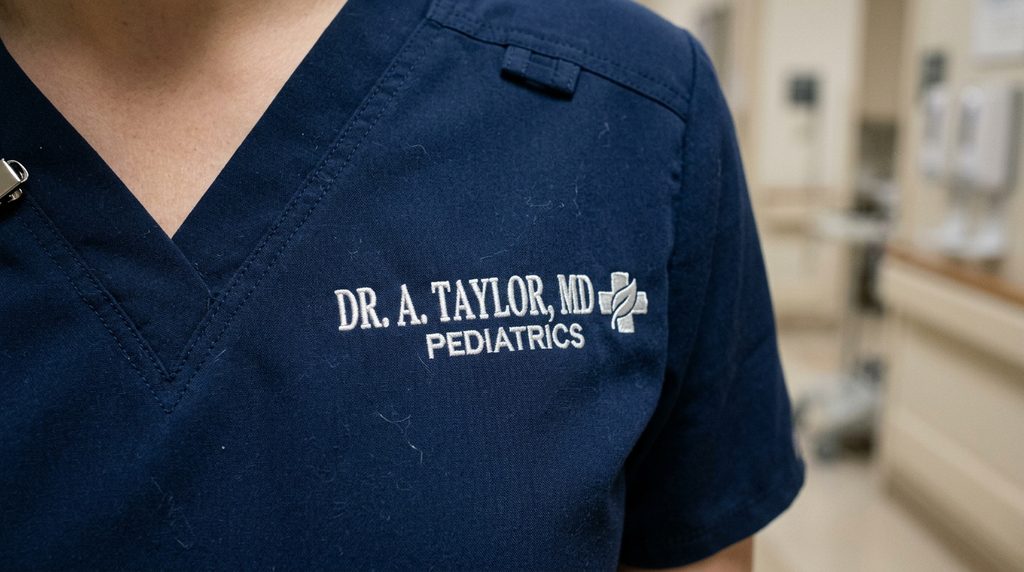
A team embroidery standard should define:
- Logo placement
- Logo size
- Thread color
- Employee name format
- Credential format
- Department name format
- Whether first names or full names are used
- Whether titles are included
- Whether providers have different formatting
- Whether jackets and lab coats use the same embroidery rules
For example, a clinic may choose left-chest logo placement for all scrub tops and jackets, with employee names and credentials on the opposite side. Another office may use logo-only embroidery for staff and full name plus credential embroidery for providers.
The key is consistency.
Build a New-Hire Uniform Process
New hires should not have to guess which scrubs to buy. A written process makes onboarding easier for both the employee and the office manager.
A new-hire uniform process may include:
- Approved scrub color
- Approved styles
- Number of starting sets
- Sizing instructions
- Ordering deadline
- Embroidery information
- Jacket or lab coat rules
- Footwear guidelines
- Replacement policy
- Who pays for uniforms
- Who approves orders
- How reorders are handled
Some offices provide a starting uniform allowance. Others require employees to purchase approved pieces. Either way, the process should be documented clearly.
Plan Uniform Quantities by Schedule
The number of uniform sets needed depends on work schedule, laundry frequency, and role. A full-time clinical employee usually needs more uniform pieces than a part-time front desk employee.
A practical starting guide may look like this:
| Role or Schedule | Suggested Starting Uniform Plan |
| Full-time clinical staff | 4 to 5 sets plus 1 backup |
| Part-time clinical staff | 2 to 3 sets plus 1 backup |
| Providers wearing lab coats | 3 to 5 scrub sets plus lab coats |
| Dental team members | 3 to 5 sets plus approved layers |
| Veterinary staff | 4 to 6 durable sets plus backups |
| Front office in scrubs | 2 to 4 sets depending on schedule |
| New hires | 2 to 3 starting sets, then add after fit is confirmed |
This is only a planning guide. Offices should adjust based on workweek length, laundering expectations, staff role, and budget.
Use Fittings Before Large Group Orders
Group uniform orders can become difficult if sizes are guessed. Staff members may wear different sizes depending on brand, fabric, fit, and pant style. A fitting process can reduce returns, exchanges, and staff frustration.
A fitting process may include:
- Trying sample tops and pants
- Comparing petite, regular, tall, and short lengths
- Testing joggers and straight-leg options
- Checking scrub jacket sizes
- Trying lab coat lengths
- Confirming embroidery placement
- Reviewing color samples
- Collecting final size selections
- Confirming employee names and credentials
A mobile scrub fitting can be useful for offices that want staff to try approved styles onsite instead of coordinating individual shopping trips.
Create a Written Uniform Policy
A written policy helps staff understand what is approved. It also prevents confusion when new employees join or when existing staff need replacement pieces.
A team scrub policy should include:
- Approved scrub colors
- Approved tops and pants
- Approved jackets
- Lab coat rules
- Embroidery rules
- Footwear basics
- Underscrub rules
- Replacement expectations
- Laundry expectations
- New-hire ordering process
- Reorder instructions
- Who to contact with sizing questions
The policy should be easy to read and practical. Overly complicated uniform policies can create confusion.
Plan for Reorders and Replacement Timing
Uniform programs should not stop after the first order. Scrubs wear out over time. Colors may fade, waistbands may stretch, cuffs may loosen, and fabric may pill. Without a replacement plan, the team can gradually become inconsistent.
Offices should decide:
- How often staff may reorder
- Whether there is an annual uniform allowance
- Whether damaged uniforms are replaced sooner
- Whether embroidery costs are covered
- Whether new hires receive starter sets
- Whether discontinued styles have replacements
- Who approves updated styles
- How size changes are handled
A replacement plan keeps the team looking consistent over time.
Standardize Without Ignoring Role Differences
Different roles may need different uniform features. A good team scrub plan accounts for those differences.
Clinical Staff
Clinical staff may need stretch fabric, useful pockets, breathable scrubs, and comfortable pants for long shifts. Pocket placement and waistband comfort matter.
Front Office Staff
Front office staff may need a polished appearance and comfortable seated fit. They may not need as many utility pockets as clinical staff.
Dental Teams
Dental workers may sit, lean, and reach throughout the day. Tops should support shoulder movement, and pants should feel comfortable while seated.
Veterinary Teams
Veterinary staff may need more durable scrubs, stronger seams, practical pockets, and easy-care fabric because of bending, lifting, cleaning, and pet hair exposure.
Providers
Doctors, nurse practitioners, physician assistants, and other providers may need scrubs that look professional under lab coats or jackets. Lab coat embroidery and fit may be especially important.
Students or Trainees
Students and trainees may need separate rules based on school or clinical program requirements. If the office hosts students, uniform expectations should be shared before the rotation begins.
Uniform Standards and Workplace Safety
Scrubs are professional workwear, but they are not replacements for required personal protective equipment. OSHA explains that personal protective equipment helps reduce exposure to workplace hazards that may cause injuries or illnesses.
Depending on the healthcare setting, staff may still need gloves, gowns, masks, eye protection, respirators, or other PPE. Uniform standards should support professional appearance and comfort, while PPE policies should follow workplace safety requirements.
Buying Team Scrubs Online or Locally
Online ordering works well after approved styles, colors, and sizes are confirmed. Local shopping or onsite fitting works better when selecting a new team standard, fitting multiple body types, checking fabric feel, or confirming embroidery placement.
A verified Dayton medical uniform store listing can help local shoppers confirm store details and directions before visiting.
Local or onsite support can help with:
- Staff fitting sessions
- Size confirmation
- Color selection
- Style comparison
- Scrub jacket selection
- Lab coat fitting
- Embroidery planning
- New-hire uniform setup
- Group order coordination
Online ordering can help with:
- Reorders
- Replacement pieces
- Additional approved sets
- Ordering outside store hours
- Maintaining uniform consistency
- Supporting staff who already know their size
A combined process often works best. Use fittings to establish the standard, then use online ordering for reorders and replacement pieces.
Common Mistakes in Team Scrub Standardization
Many team uniform problems happen because offices make decisions too quickly without considering fit, reorders, and staff comfort.
Avoid these mistakes:
- Choosing colors without checking long-term availability
- Requiring one pant style for every body type
- Ignoring petite, tall, or short inseam needs
- Allowing too many colors without a clear system
- Forgetting scrub jacket rules
- Skipping embroidery standards
- Guessing sizes for group orders
- Buying large quantities before staff fittings
- Ignoring laundering and replacement timing
- Overlooking new-hire ordering steps
- Not documenting the uniform policy
- Treating scrubs as replacements for required PPE
A good team uniform program should be clear, flexible, and easy to maintain.
Final Thoughts
Healthcare offices can standardize team scrub colors and styles by creating a clear system for approved colors, scrub tops, pants, jackets, lab coats, embroidery, sizing, group ordering, and replacement timing. The strongest plans combine professional consistency with enough fit flexibility for different roles and body types.
Before placing a group order, office leaders should confirm workplace needs, choose practical fabric and style options, set embroidery rules, plan fittings, and write a simple uniform policy. A well-built scrub standard can help teams look organized, stay comfortable, and keep uniform ordering easier over time.
FAQs
How should healthcare offices choose scrub colors for staff?
Healthcare offices should choose scrub colors based on role visibility, department organization, professional appearance, and long-term availability. Small offices may use one color for everyone, while larger clinics may assign colors by department, role, or location.
Should every staff member wear the same scrub style?
Not always. Teams can maintain consistency by using approved colors and approved collections while allowing different fits, inseams, and pant styles. This helps staff choose uniforms that fit their body type while keeping the overall team appearance consistent.
How many scrub sets should a healthcare office order for each employee?
Many full-time clinical employees need 4 to 5 scrub sets plus one backup. Part-time staff may need fewer. New hires may start with 2 to 3 sets and add more after sizing is confirmed. The final number depends on schedule, budget, and laundering routine.
Is embroidery necessary for team scrubs?
Embroidery is not always necessary, but it can make team uniforms look more polished and consistent. If embroidery is used, offices should standardize logo placement, name format, credential format, thread color, and which garments receive embroidery.
Why are fittings important for group scrub orders?
Fittings help staff choose the right size, inseam, fit, and style before a large order is placed. This can reduce returns, sizing problems, discomfort, and inconsistent appearance. Fittings are especially helpful when ordering for different body types and roles.