


A stethoscope carrying case can help protect an important clinical instrument from pressure, tangling, scratches, and contact with other items during daily transport. The right case should fit the stethoscope securely without compressing it unnecessarily, while providing enough protection for the way the instrument is carried, stored, and used.
For healthcare professionals and students who routinely transport a stethoscope between home, school, clinical sites, hospitals, and offices, the best case balances protection, size, accessibility, durability, and portability. A compact soft case may be enough for everyday commuting, while a more structured design can make sense when the stethoscope travels inside a heavily loaded medical backpack.
Key Takeaways
- A stethoscope case should fit the instrument securely without forcing it into a tight space.
- Protective padding can reduce pressure and contact with other items during transport.
- A hard or semi-rigid case generally provides more structural protection than a thin soft pouch.
- Soft cases can be lighter and easier to pack into a larger work bag.
- Internal straps, elastic loops, and compartments can help keep the stethoscope organized.
- The case should accommodate the stethoscope’s tubing, chestpiece, and other components without excessive bending.
- A larger case is not automatically better because unused space adds bulk.
- Materials should be evaluated for durability, cleaning requirements, and everyday use.
- Students and professionals who carry additional equipment may benefit from a case that fits inside a dedicated medical equipment backpack.
- The case should complement appropriate cleaning and handling practices rather than replace them.
Why Use a Stethoscope Carrying Case?
A stethoscope is designed for repeated clinical use, but transporting it loose inside a backpack, tote, or scrub bag can expose it to unnecessary contact with other objects.
A dedicated case can help:
- Keep the tubing organized
- Reduce tangling
- Separate the stethoscope from heavier objects
- Protect the chestpiece
- Reduce surface scratches
- Keep small accessories together
- Make the instrument easier to locate
A case is particularly useful when a stethoscope regularly travels between multiple locations.
Instead of placing it underneath books, electronics, chargers, clothing, and other equipment, the instrument can remain inside a dedicated protective compartment.
Does Every Healthcare Professional Need a Stethoscope Case?
Not necessarily.
Someone who keeps a stethoscope primarily at a workstation or carries it directly around the neck may have little need for a separate case.
A carrying case becomes more useful when the stethoscope is frequently:
- Transported in a backpack
- Packed alongside books
- Carried between clinical sites
- Stored with electronic equipment
- Transported in a vehicle
- Packed inside a larger work bag
The decision should therefore be based on transportation and storage habits rather than profession alone.
What Should a Stethoscope Case Protect?
A stethoscope case should primarily protect the instrument from ordinary transport-related problems.
These can include:
- Pressure from other objects
- Accidental drops
- Scratching
- Tangling
- Compression of tubing
- Contact with loose equipment
A case does not need to be excessively large or heavily padded to provide useful protection.
The appropriate level depends on how the stethoscope is transported.
Which Parts of a Stethoscope Need Protection?
A typical stethoscope includes several components that may benefit from organized storage.
Chestpiece
The chestpiece is a key working component and should not be allowed to move freely against hard objects.
Tubing
Tubing is flexible, but repeated unnecessary bending, crushing, or tight folding should be avoided.
Eartips and Binaural Assembly
The upper portion of the instrument should be stored without forcing the binaural assembly into an unnatural position.
Small Accessories
Some users may also carry:
- Spare eartips
- Identification accessories
- Cleaning supplies approved for the instrument
- Small replacement components
A case with a small accessory pocket can keep these items separate.
What Makes a Good Stethoscope Carrying Case?
The best case depends on the stethoscope and how it will be transported.
Important factors include:
- Internal dimensions
- Padding
- Structural rigidity
- Closure
- Interior organization
- Material
- Weight
- Portability
- Cleaning requirements
A good case should protect the instrument without becoming so bulky that it is inconvenient to carry.
How Should a Stethoscope Fit Inside Its Case?
The stethoscope should fit comfortably without being forced into an excessively compressed position.

Look for enough internal room for:
- Chestpiece
- Tubing
- Binaural section
- Eartips
The case should close without placing unusual pressure on the instrument.
Signs a Case Is Too Small
The case may be too small if:
- The tubing must be sharply folded
- The chestpiece presses against the case
- The lid pushes directly against the instrument
- The case closure requires force
- The stethoscope cannot be positioned naturally
A slightly larger case can be preferable to a case that forces the instrument into a restrictive configuration.
Signs a Case Is Too Large
An oversized case can:
- Take unnecessary bag space
- Add bulk
- Allow the stethoscope to move around
- Provide little additional practical benefit
The ideal case leaves enough room for protection without excessive empty space.
Hard vs Soft Stethoscope Cases
One of the most important decisions is whether to choose a rigid case or a soft case.
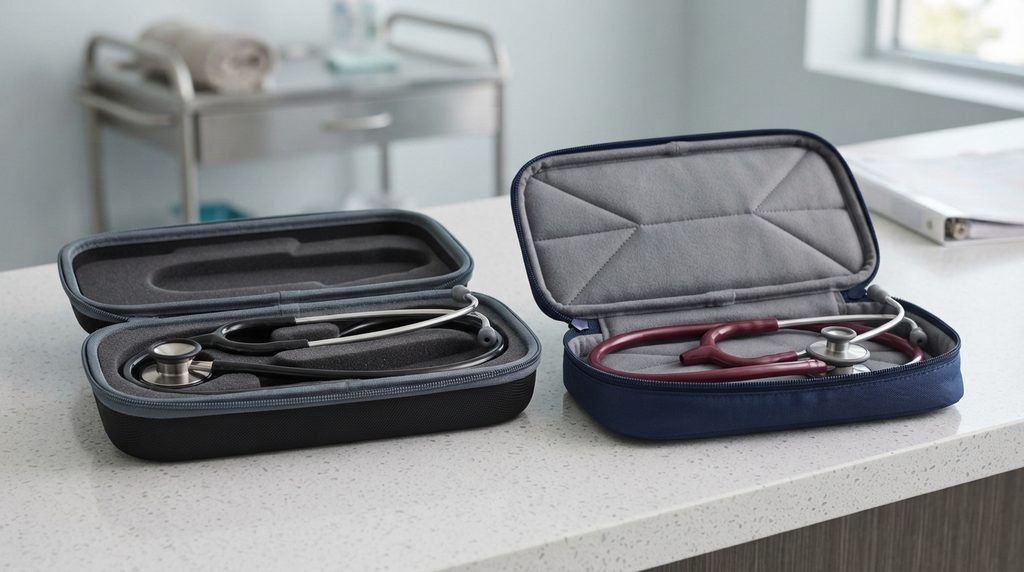
| Feature | Hard/Semi-Rigid Case | Soft Case |
| Structural Protection | Higher | Moderate |
| Weight | Usually higher | Usually lower |
| Storage Space | More rigid | More flexible |
| Compression Resistance | Stronger | Lower |
| Portability | Bulkier | Easier to pack |
| Flexibility | Limited | Higher |
| Best Use | Higher protection needs | Everyday lightweight transport |
Neither construction is universally better.
The appropriate choice depends on how the stethoscope is carried.
What Are the Benefits of a Hard Stethoscope Case?
A hard or semi-rigid case provides a stronger physical barrier around the instrument.
It may be useful when the stethoscope is transported inside a bag containing:
- Textbooks
- Laptop
- Tablet
- Chargers
- Other equipment
The rigid exterior can reduce the likelihood that surrounding objects directly compress the stethoscope.
When Is a Hard Case Most Useful?
Consider one when the stethoscope is frequently:
- Packed into a crowded backpack
- Transported between locations
- Stored beneath other objects
- Carried alongside heavier equipment
The additional protection comes with additional size and weight, so it should be justified by the transport conditions.
What Are the Benefits of a Soft Stethoscope Case?
Soft cases can be lightweight and easy to transport.
Potential advantages include:
- Lower weight
- Less bulk
- Easier packing
- Flexible storage
- Simple access
A soft case may be sufficient when the stethoscope is carried inside a relatively organized backpack without heavy objects pressing against it.
What Is a Semi-Rigid Stethoscope Case?
A semi-rigid case combines elements of both designs.
It can provide:
- More structure than a fabric pouch
- Less bulk than some fully rigid cases
- Moderate protection
- Easier packing
This can be a practical middle ground for users who want protection without carrying a bulky hard shell.
How Important Is Stethoscope Case Padding?
Padding can provide an additional barrier between the instrument and the case exterior.
Useful padding should:
- Cover relevant surfaces
- Maintain its shape
- Avoid excessive compression
- Allow the case to close normally
More padding is not automatically better.
Excessive padding can make the case:
- Larger
- Heavier
- Less flexible
The goal is adequate protection for the actual transport environment.
Should a Stethoscope Case Have Internal Straps?
Internal straps or elastic loops can help keep the stethoscope in a predictable position.
They can prevent the instrument from:
- Sliding around
- Becoming tangled
- Moving against the case walls
A strap should secure the instrument without tightly compressing the tubing.
What Should the Strap Hold?
The case should secure the stethoscope at an appropriate location rather than forcing the tubing into an unnatural position.
If a strap creates a sharp bend or strong pressure point, another storage configuration may be preferable.
Are Mesh Pockets Useful in a Stethoscope Case?
A small mesh or accessory pocket can provide a convenient location for lightweight items.
Potential contents include:
- Spare eartips
- Small cleaning accessories
- Replacement components
- Other approved small items
The pocket should not be overloaded.
Heavy objects can shift inside the case and potentially press against the stethoscope.
Should a Stethoscope Case Have Space for Two Stethoscopes?
Some professionals may need to transport more than one instrument, but most individual users only need space for one.
A two-stethoscope case can be useful for:
- Students sharing equipment
- Professionals carrying different instruments
- Training environments
- Situations where multiple instruments are legitimately required
However, a larger case should not be purchased simply because it offers more capacity.
Extra space adds:
- Bulk
- Weight
- Storage requirements
Choose capacity according to actual use.
Can a Stethoscope Case Fit Inside a Medical Backpack?
Yes.
A compact case can provide an additional layer of organization inside a larger medical equipment backpack.
Professionals who regularly carry equipment can review medical equipment backpacks to find a larger transport system with enough space for a protected stethoscope case.
A useful combination can be:
Stethoscope → Protective case → Organized backpack compartment
This creates multiple levels of organization without requiring the stethoscope to move freely among unrelated items.
What Size Stethoscope Case Should You Buy?
Case dimensions should be compared with the actual stethoscope.
Before purchasing, consider:
- Total instrument length
- Chestpiece size
- Tubing configuration
- Binaural shape
- Additional accessories
Manufacturers may describe cases as compatible with “standard” or “most” stethoscopes, but those descriptions do not guarantee an ideal fit for every model.
Measure Before Ordering
If the case dimensions are listed, compare them with the stethoscope and allow enough room for comfortable placement.
Do not assume that a case’s external dimensions equal its usable internal dimensions.
Padding and construction reduce interior space.
What Materials Are Used for Stethoscope Cases?
Common materials include:
- EVA
- Nylon
- Polyester
- Fabric
- Synthetic leather
- Other molded synthetic materials
Each can offer different combinations of:
- Rigidity
- Weight
- Water resistance
- Durability
- Cleanability
What Is EVA?
EVA, or ethylene-vinyl acetate, is commonly used in semi-rigid molded protective cases.
It can provide:
- Lightweight structure
- Impact resistance
- Shape retention
EVA cases are often associated with molded protective designs.
What About Nylon and Polyester?
These synthetic fabrics can provide lightweight construction and durability.
They are commonly used in soft or semi-structured cases.
The quality of:
- Stitching
- Zippers
- Padding
- Interior lining
can matter just as much as the outer fabric.
Should a Stethoscope Case Be Water-Resistant?
Water resistance can be useful during everyday transportation.
It may provide additional protection against:
- Light rain
- Accidental splashes
- Moisture inside a bag
However, water-resistant does not mean waterproof.
A water-resistant case should not be treated as a guarantee that the instrument can safely be submerged or exposed to significant moisture.
Follow the stethoscope manufacturer’s care and storage instructions for more specific requirements.
Is an Easy-to-Clean Stethoscope Case Important?
It can be useful, especially when the case is used regularly in healthcare environments.
Consider surfaces that are:
- Smooth
- Durable
- Easy to inspect
- Compatible with appropriate cleaning procedures
Not every case material can tolerate every disinfectant.
Before cleaning, check the case manufacturer’s instructions and the stethoscope manufacturer’s recommendations for the instrument itself.
Should the Inside and Outside Be Cleaned the Same Way?
Not necessarily.
Different materials may require different care.
A fabric exterior may have different cleaning requirements from:
- Molded EVA
- Plastic components
- Synthetic leather
- Mesh
Do not assume that a cleaning product suitable for one surface is suitable for another.
Can a Stethoscope Case Prevent Contamination?
A case can help separate the stethoscope from unrelated objects during transportation, but it does not make the instrument sterile.
The case itself can also become contaminated if it is handled in environments where contamination occurs.
CDC’s infection-control guidance emphasizes appropriate cleaning and disinfection practices for reusable equipment according to the type of equipment and intended use. CDC Infection Control and Core Practices
A carrying case should therefore be treated as a transport and storage accessory rather than a substitute for cleaning the stethoscope according to manufacturer and workplace requirements.
How Should a Stethoscope Be Stored Between Uses?
Storage should protect the instrument from unnecessary:
- Pressure
- Heat
- Moisture
- Tangling
- Impact
When a case is used, keep the stethoscope positioned naturally rather than tightly coiled.
The instrument should be stored according to the manufacturer’s recommendations.
Should You Coil a Stethoscope Inside Its Case?
A stethoscope often needs to be positioned within a compact space, but it should not be forced into sharp or unnatural bends simply to make it fit.
A case with enough internal room allows the tubing to follow a relatively gentle curve.
If the case requires aggressive folding, choose a larger or differently shaped case.
How Should the Tubing Be Positioned?
Tubing should not be tightly twisted around the chestpiece or compressed under heavy objects.
When placing the stethoscope into a case:
- Separate the tubing from other items.
- Position the chestpiece securely.
- Follow the natural curve of the tubing.
- Avoid sharp bends.
- Secure the instrument if an internal strap is provided.
- Close the case without forcing the lid.
This can make storage more consistent and reduce unnecessary handling.
Should the Chestpiece Have Its Own Compartment?
A dedicated section can be useful.
It can prevent the chestpiece from moving against:
- Zippers
- Pens
- Chargers
- Books
- Other equipment
A molded or padded recess can provide additional stability.
However, a dedicated chestpiece section is not mandatory if the overall case securely protects the entire instrument.
Is a Zippered Stethoscope Case Better?
Zippers are common because they can provide full closure around the instrument.
A good zipper should:
- Operate smoothly
- Close completely
- Have secure stitching
- Avoid catching the interior lining
The zipper should not press directly against the stethoscope.
A protective interior lining can create additional separation.
Are Snap or Magnetic Closures Suitable?
They can be convenient, particularly for lightweight cases.
However, the closure should remain secure during normal movement.
If carrying sensitive electronic equipment alongside the case, follow the equipment manufacturer’s storage recommendations rather than assuming a particular closure system is universally appropriate.
What Makes a Stethoscope Case Durable?
Durability depends on the complete construction.
Look at:
- Outer material
- Stitching
- Zipper quality
- Strap attachment
- Interior lining
- Padding
- Bottom construction
A visually attractive case can still fail quickly if the zipper or stitching is weak.
Where Does a Stethoscope Case Usually Fail?
Common stress points include:
- Zipper ends
- Handle attachments
- Strap connection points
- Seams
- Interior elastic loops
Inspect these areas when evaluating a case for frequent use.
Should a Stethoscope Case Have a Handle?
A handle can make the case easier to carry separately from a backpack.
This can be useful when:
- Moving between classrooms
- Entering clinical areas
- Taking the stethoscope to a skills lab
- Carrying the case from a vehicle
A handle is less important when the case will remain inside another work bag.
Can a Stethoscope Case Be Carried With Scrubs?
Yes.
The case can be transported separately or inside a scrub bag or medical backpack.
Healthcare professionals who need additional storage can explore scrub bags for nurses when deciding how a stethoscope case should fit into their broader workwear organization system.
The case should remain easy to access without requiring unnecessary unpacking.
What Should Nursing Students Look for in a Stethoscope Case?
Nursing students often transport their stethoscope between:
- Home
- Classroom
- Simulation lab
- Clinical placement
- Study locations
A practical case may therefore prioritize:
- Compact size
- Moderate protection
- Lightweight construction
- Easy access
- Space for small accessories
Students who carry textbooks and electronics may benefit from a more structured case.
What Should Nurses Look for in a Stethoscope Case?
Nurses may use their stethoscope repeatedly during a shift and may also transport it between work and home.
Consider:
- Quick access
- Secure closure
- Compact storage
- Comfortable transport
- Easy maintenance
The ideal case should not add unnecessary bulk to an already loaded work bag.
What Should Medical Students Look for in a Stethoscope Case?
Medical students may carry:
- Stethoscope
- Laptop
- Tablet
- Textbooks
- Notebook
- Other clinical equipment
A semi-rigid or structured case can provide useful protection inside a larger backpack.
A case with an accessory pocket may also help keep smaller items together.
What Should Physicians Look for in a Stethoscope Case?
Physicians who transport a stethoscope primarily between home and clinic may prefer a compact case.
Priorities may include:
- Minimal bulk
- Lightweight construction
- Quick access
- Secure storage
If the stethoscope is primarily worn during the workday, an elaborate case may not be necessary.
How Should Veterinary Professionals Choose a Stethoscope Case?
Veterinary professionals may transport equipment through environments with different exposure conditions from conventional office or hospital settings.
A useful case should be:
- Durable
- Easy to maintain
- Securely closed
- Appropriately sized
- Easy to organize
Material selection becomes particularly important if the case will encounter dirt, animal hair, or other environmental debris.
Should a Stethoscope Case Go Inside a Scrub Bag?
It can.
A dedicated case provides additional organization within a larger scrub bag.
A practical setup might be:
- Main scrub bag compartment: clothing and larger items
- Equipment section: stethoscope case
- Small accessory pocket: pens and other lightweight items
The exact arrangement depends on the bag and the user’s work routine.
How Can You Prevent a Stethoscope Case From Taking Too Much Space?
Choose the smallest case that comfortably accommodates the instrument.
Avoid automatically selecting:
- Oversized hard shells
- Multiple accessory compartments
- Large double-instrument cases
if those features are not needed.
A compact case can be easier to fit into a larger backpack.
Can You Carry Other Medical Equipment in a Stethoscope Case?
Only if the case is designed or sized appropriately for those items.
Do not force unrelated equipment into the same compartment.
Heavy or sharp objects should not be placed next to the stethoscope simply because they fit.
The case should remain primarily organized around protecting its intended contents.
How Should You Clean a Stethoscope Case?
Start by checking the case manufacturer’s care instructions.
A general maintenance process can include:
- Remove the stethoscope.
- Empty all accessory compartments.
- Remove loose debris.
- Clean the exterior according to manufacturer instructions.
- Clean interior surfaces when appropriate.
- Allow the case to dry completely.
- Inspect the zipper and seams.
- Return the stethoscope only after the case is ready.
Avoid saturating padded or fabric interiors unless the manufacturer specifically permits that method.
How Often Should a Stethoscope Case Be Cleaned?
There is no single schedule that applies to every case.
Frequency depends on:
- How often it is used
- Where it travels
- Whether it becomes visibly soiled
- Workplace requirements
- Manufacturer instructions
A case that remains in a personal backpack may require different maintenance from one routinely used in multiple clinical environments.
What Should You Look for in a Stethoscope Case Before Buying?
A practical checklist can make the selection process easier.
Fit
- Stethoscope fits without force
- Tubing is not sharply bent
- Chestpiece is protected
- Case closes easily
Protection
- Exterior provides appropriate structure
- Padding protects key areas
- Heavy objects cannot easily press directly against the instrument
Organization
- Internal straps are useful
- Small accessories have appropriate storage
- Contents do not move excessively
Portability
- Case fits the work bag
- Empty case is not unnecessarily heavy
- Handle is comfortable when needed
Maintenance
- Cleaning instructions are available
- Material suits the intended environment
- Interior can be inspected easily
Durability
- Zipper moves smoothly
- Seams appear secure
- Handle attachment is reinforced
- Padding remains consistent
How Should You Choose a Stethoscope Case Online?
When shopping for a stethoscope carrying case, product photographs should be treated as only one part of the evaluation.
Review:
- Internal dimensions
- External dimensions
- Material
- Weight
- Closure type
- Padding
- Internal compartments
- Compatibility information
- Cleaning instructions
Compare Internal Dimensions
If the seller provides only external dimensions, remember that padding and construction reduce usable space.
Look for photographs showing the interior.
Check the Closure
The case should close without requiring the instrument to be compressed.
Review User Photos When Available
Customer photographs can sometimes provide useful information about:
- Actual scale
- Internal space
- Tubing fit
- Construction
However, product specifications should remain the primary reference.
Should You Buy the Case Before the Stethoscope?
If possible, choosing the stethoscope first can make case selection easier.
Once the instrument is known, compare:
- Length
- Chestpiece dimensions
- Tubing configuration
- Binaural design
Then select a case that provides a comfortable fit.
If the case is purchased first, choose one with clearly stated internal dimensions and a return policy that allows compatibility problems to be addressed.
What If the Stethoscope Does Not Fit the Case?
Do not force it.
A case that requires excessive compression may not be the appropriate size.
Consider:
- Larger case
- Different internal layout
- Semi-rigid case
- Soft case with more flexible storage
- Manufacturer-specific case
The case should accommodate the instrument rather than requiring the instrument to conform to an unsuitable enclosure.
How Should You Test a Stethoscope Case Before Using It Daily?
A short test can reveal most obvious problems.

Test 1: Fit
Place the complete stethoscope inside.
Test 2: Closure
Close the case without forcing it.
Test 3: Movement
Gently move the closed case around.
Listen for excessive internal movement.
Test 4: Carrying
Place it inside the normal work bag.
Check whether other items can be packed comfortably.
Test 5: Access
Open the case and remove the stethoscope.
The process should be straightforward.
Test 6: Repacking
Return the stethoscope to the case.
The same organization should be easy to repeat.
Where Can You Compare Stethoscope Cases in Person?
In-person shopping can be useful when case dimensions, padding, and construction are difficult to judge online.
Healthcare professionals looking for the best stethoscope case can compare case sizes and broader scrub-bag options at a medical uniform store in Lincoln. Find a medical scrub store in Lincoln to evaluate available workwear and accessory options in person.
When comparing cases, physically test whether the stethoscope fits without excessive bending and whether the case can comfortably fit into the intended work bag.
Common Stethoscope Case Buying Mistakes
Choosing the Largest Case
Extra space can add unnecessary bulk.
Choosing the Smallest Case
A tight case can force the stethoscope into an unsuitable position.
Ignoring Internal Dimensions
External dimensions do not reveal usable storage space.
Buying Based Only on Appearance
A stylish case may still have poor padding or weak construction.
Ignoring the Zipper
A weak closure can become a daily frustration.
Overloading Accessory Pockets
Extra contents can add pressure against the stethoscope.
Choosing a Hard Case Without Considering Bag Space
Rigid cases provide protection but occupy more room.
Choosing a Soft Case When Heavy Compression Is Likely
A thin pouch may not provide enough structural protection inside a crowded bag.
Forgetting About Cleaning
A case used regularly should have practical maintenance requirements.
Assuming a Case Makes the Stethoscope Sterile
A transport case provides organization and protection. It does not replace appropriate instrument cleaning or infection-control procedures.
Stethoscope Case Buying Checklist
Before purchasing, ask:
- Does the case fit the complete stethoscope?
- Is there enough room for the tubing?
- Is the chestpiece protected?
- Can the case close without force?
- Is the padding appropriate?
- Does the case have useful internal organization?
- Is the case compatible with the work bag?
- Is the empty weight reasonable?
- Can the material be maintained appropriately?
- Are the zipper and seams durable?
- Does the design match the actual transport environment?
- Is the return policy suitable if the fit is incorrect?
Conclusion
A stethoscope carrying case should protect the instrument without becoming another source of bulk and inconvenience.
The most important considerations are:
- Correct internal fit
- Appropriate protection
- Tubing-friendly storage
- Secure closure
- Useful organization
- Reasonable weight
- Durable construction
- Practical maintenance
A hard or semi-rigid case can make sense when the stethoscope travels inside a crowded backpack, while a lightweight soft case may be sufficient for simpler transportation.
The correct choice ultimately depends on the instrument, the work routine, and the way the case will be transported.
A good stethoscope case should make daily transport simpler: the instrument stays organized, protected, easy to locate, and ready for use without taking up more space than necessary.
Frequently Asked Questions
What is the best type of stethoscope carrying case?
The best case depends on how the stethoscope is transported. A hard or semi-rigid case provides more structural protection, while a soft case is lighter and easier to pack. Fit, padding, organization, and portability are more important than choosing one construction type universally.
Should a stethoscope be kept in a case?
A case is particularly useful when a stethoscope is regularly transported in a backpack, tote, or other work bag. It can reduce tangling, protect the instrument from surrounding objects, and keep it organized.
How should a stethoscope fit inside its case?
The stethoscope should fit without being forced into sharp bends or excessive compression. The chestpiece should remain protected, the tubing should follow a relatively natural curve, and the case should close without pressing heavily against the instrument.
Are hard stethoscope cases better than soft cases?
Hard cases generally provide more structural protection, while soft cases tend to be lighter and more flexible. A hard case may be useful inside a crowded backpack, whereas a soft case can be sufficient for less demanding transportation.
Can a stethoscope case fit inside a medical backpack?
Yes. A compact stethoscope case can provide a dedicated protective layer inside a larger medical equipment backpack. Check the backpack’s compartment dimensions and the case’s external dimensions before purchasing.
How do you clean a stethoscope carrying case?
Follow the case manufacturer’s care instructions. Remove the stethoscope and accessories, clear loose debris, clean compatible surfaces using the recommended method, allow the case to dry completely, and inspect it before returning the instrument.
Does a stethoscope case protect against contamination?
A case can separate the stethoscope from other objects during transport, but it does not make the instrument sterile. The stethoscope and case should be maintained according to applicable manufacturer instructions and workplace infection-control procedures.
How do you know if a stethoscope case is too small?
A case is likely too small if the stethoscope must be sharply folded, the chestpiece presses against the interior, the tubing is heavily compressed, or the closure requires force. The instrument should fit comfortably without being forced.