

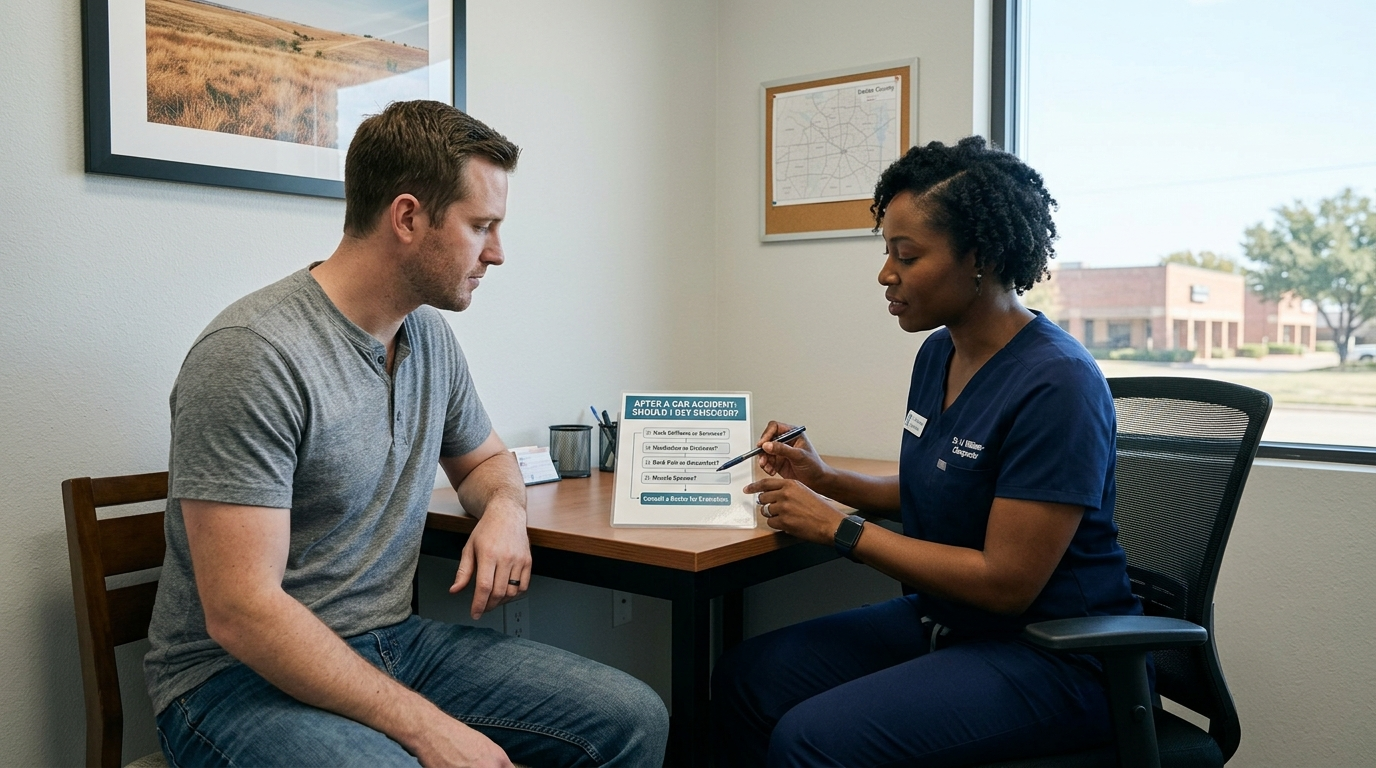
After a car accident, many people ask the same question:
“Do I really need to see a doctor?”
The answer depends on what your body is doing after the crash.
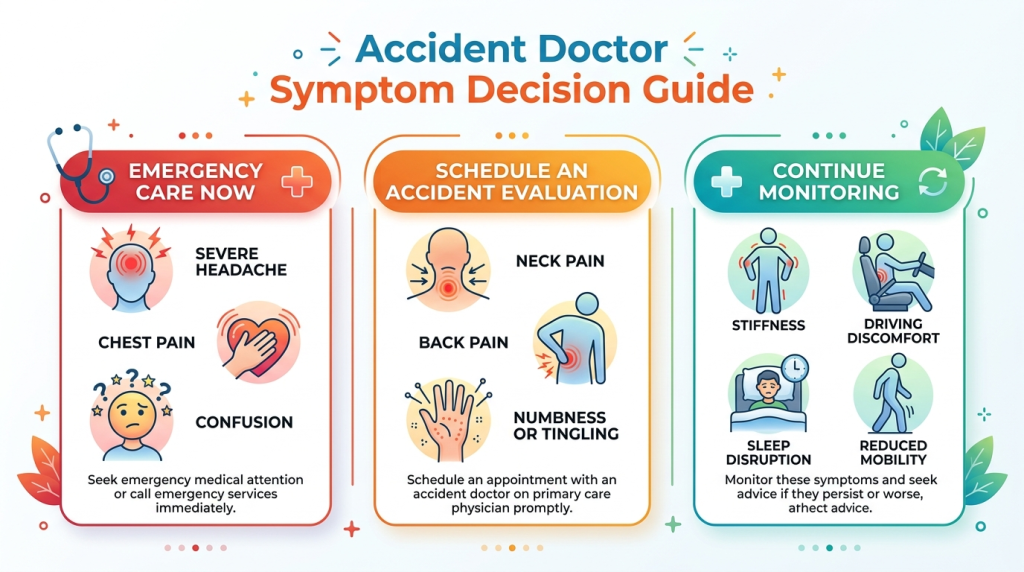
Some symptoms require emergency medical care immediately. Some symptoms may be monitored for a short time if they are mild and improving. Other symptoms may not be an emergency, but they still deserve an accident-focused evaluation because they affect movement, comfort, sleep, work, or daily function.
The difficult part is that accident symptoms do not always appear right away.
You may feel fine at the scene, then notice neck pain, back pain, headaches, stiffness, soreness, numbness, tingling, or reduced mobility hours or days later. That delay can make it hard to know when to get checked.
If you are looking for an accident and injury doctor after a crash, Premier Injury Clinics of DFW’s Mesquite location provides accident-focused chiropractic care, rehabilitation therapy, same-day evaluations when available, structured recovery plans, and transportation assistance for qualifying patients.
Quick Answer
You should consider visiting an accident doctor if pain, stiffness, headaches, numbness, tingling, or reduced mobility appears after a car accident, especially if symptoms continue, worsen, or affect daily activities such as driving, working, sleeping, walking, sitting, standing, bending, or lifting.
Seek emergency care first if symptoms are severe or include loss of consciousness, chest pain, trouble breathing, confusion, repeated vomiting, weakness, slurred speech, severe headache, heavy bleeding, severe abdominal pain, or severe neck or back pain after trauma.
The U.S. Department of Transportation describes post-crash care as part of a safer crash response system, especially when timely care is needed after serious crashes.
For non-emergency accident symptoms, an accident-focused evaluation may help determine whether chiropractic care, rehabilitation therapy, mobility exercises, soft tissue support, progress monitoring, or additional medical evaluation may be appropriate.
Key Takeaways
- You do not need to wait for severe pain before paying attention to accident symptoms.
- Some accident-related symptoms appear hours or days after a crash.
- Emergency red flags should always be handled through emergency medical care first.
- Neck pain, back pain, headaches, stiffness, soreness, numbness, tingling, and reduced mobility may be reasons to consider an accident-focused evaluation.
- Chiropractic care may help evaluate musculoskeletal symptoms after a crash.
- Rehabilitation therapy may support movement, strength, flexibility, stability, and return to daily function.
- Local Mesquite care may make follow-up easier for patients near Sunnyvale, Balch Springs, Garland, Forney, and nearby East Dallas County communities.
The Accident Doctor Visit Decision Guide
The question is not only “How bad is the pain?”
A better question is:
“Is this symptom affecting safety, movement, or daily function?”
Use this guide to sort the next step.
| Symptom Situation | What It May Mean | Suggested Next Step |
| Severe or worsening symptoms | Possible emergency concern | Seek emergency care immediately |
| Mild soreness that improves quickly | May be short-term soreness | Continue monitoring symptoms |
| Pain that appears hours or days later | Possible delayed accident symptom | Consider an accident-focused evaluation |
| Pain that affects driving, work, sleep, or walking | Function is being affected | Schedule an evaluation |
| Numbness, tingling, weakness, or radiating pain | May need prompt review | Get evaluated and seek emergency care if severe |
| Headache with confusion, vomiting, weakness, or slurred speech | Possible serious warning sign | Seek emergency care immediately |
| Stiffness that limits normal movement | Mobility may be affected | Consider chiropractic and rehab evaluation |
This guide is not a diagnosis. It is a practical way to decide when symptoms should not be ignored.
When Emergency Care Should Come First
Before thinking about chiropractic care or rehabilitation therapy, serious symptoms should be handled first.
Seek emergency medical care immediately if you experience:
- Loss of consciousness
- Chest pain
- Trouble breathing
- Heavy bleeding
- Confusion
- Repeated vomiting
- Severe or worsening headache
- Weakness on one side of the body
- Slurred speech
- Severe abdominal pain
- Severe neck or back pain after trauma
- Numbness or weakness in the arms or legs
- Loss of bladder or bowel control
- Seizure
- Unequal pupils
- Unusual behavior after head trauma
The CDC lists danger signs after possible traumatic brain injury or concussion, including worsening headache, repeated vomiting, weakness, numbness, seizures, slurred speech, confusion, unusual behavior, unequal pupils, and loss of consciousness.
When in doubt, emergency care should come first. Once serious conditions are ruled out, accident-focused chiropractic care and rehabilitation may be part of the recovery process.
When Symptoms Can Be Monitored Briefly
Not every ache means you need ongoing treatment.
Some mild soreness may improve with rest, gentle movement, and time. If symptoms are mild, not worsening, and not limiting your normal activities, you may choose to monitor them carefully for a short period.
Monitoring may make sense when:
- Soreness is mild
- Movement feels normal
- Pain is not worsening
- Sleep is not affected
- Driving feels normal
- There is no numbness or tingling
- There are no headaches or neurological symptoms
- Symptoms improve instead of spreading or intensifying
Even then, continue paying attention for several days. Accident-related symptoms can appear later.
When You Should Consider an Accident-Focused Evaluation
You should consider visiting an accident doctor when symptoms continue, worsen, appear later, or interfere with daily life.
Visit an Accident Doctor If Neck Pain Appears
Neck pain after a crash may be related to whiplash, muscle strain, ligament stress, joint irritation, or soft tissue injury.
Neck pain may affect:
- Turning the head
- Checking blind spots
- Sleeping
- Looking down at a phone
- Working at a desk
- Lifting or carrying items
- Driving comfortably
Mayo Clinic explains that whiplash can happen when the neck moves forcefully and rapidly back and forth. Symptoms may include neck pain, stiffness, headaches, shoulder or upper back discomfort, reduced range of motion, tingling, tiredness, and dizziness.
If neck pain limits normal movement or continues after a crash, an accident-focused evaluation may help determine the next step.
Visit an Accident Doctor If Back Pain Affects Movement
Back pain after a car accident may involve muscle strain, spinal joint irritation, inflammation, soft tissue injury, or another injury pattern.
It may become noticeable while:
- Sitting
- Standing
- Walking
- Bending
- Lifting
- Driving
- Sleeping
- Getting in and out of a vehicle
- Returning to work duties
Back pain should be evaluated if it persists, worsens, travels into the hips or legs, or limits normal activity.
Visit an Accident Doctor If Headaches Begin After the Crash
Headaches after an accident may be related to neck strain, whiplash, muscle tension, concussion concerns, direct impact, or posture changes after injury.
A headache should be treated as urgent if it is severe, worsening, or appears with:
- Confusion
- Repeated vomiting
- Dizziness that worsens
- Slurred speech
- Weakness
- Vision changes
- Seizure
- Loss of consciousness
- Numbness
- Unusual behavior
For non-emergency headaches that appear after a crash, especially when paired with neck stiffness or upper back pain, an accident-focused evaluation may be appropriate.
Visit an Accident Doctor If Numbness or Tingling Appears
Numbness, tingling, weakness, or radiating pain should be taken seriously.
These symptoms may affect:
- Arms
- Hands
- Legs
- Feet
- Neck
- Back
- Shoulders
- Hips
If numbness or tingling appears after a crash, report it clearly. If it is severe, sudden, worsening, or paired with weakness, loss of coordination, slurred speech, or confusion, seek emergency care.
Visit an Accident Doctor If Daily Tasks Feel Different
Sometimes the clearest sign is not pain at rest. It is pain during normal life.
Consider an evaluation if symptoms affect:
- Driving
- Checking mirrors or blind spots
- Sitting through work
- Standing after sitting
- Walking through a store
- Climbing stairs
- Lifting groceries
- Carrying a child
- Sleeping through the night
- Reaching overhead
- Returning to exercise
- Completing job duties
Daily function matters because recovery is not only about how much pain you feel. It is also about how well your body moves.
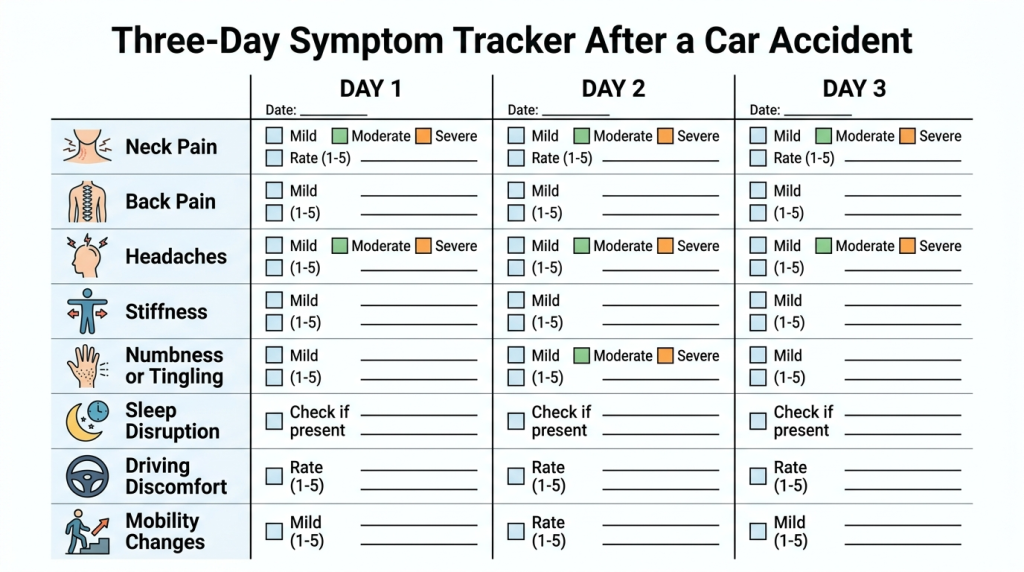
The “Three-Day Change” Rule
Many accident symptoms become clearer during the first few days.
Use this simple rule:
If symptoms are new, worsening, or still affecting normal movement after a few days, consider getting evaluated.
This does not mean every patient needs the same care. It means symptoms should not be dismissed just because they were delayed.
Track:
- Did the pain start later?
- Is stiffness worse in the morning?
- Does driving increase discomfort?
- Are headaches new?
- Is sleep affected?
- Is pain spreading?
- Is numbness or tingling present?
- Is movement more limited than usual?
These details can help an accident doctor understand the symptom pattern.
What an Accident Doctor May Evaluate
An accident-focused evaluation is designed to connect symptoms with movement, function, and recovery needs.
A first visit may include:
- Discussion of the accident
- Review of when symptoms started
- Pain location review
- Neck and back mobility checks
- Range-of-motion review
- Soft tissue symptom discussion
- Pain and tenderness assessment
- Functional movement screening
- Review of driving, work, sleep, and daily activity limitations
- Treatment recommendations
- Recovery plan discussion
- Progress-monitoring plan
The goal is to understand how the crash affected the body and whether chiropractic care, rehabilitation therapy, soft tissue support, mobility exercises, or additional evaluation may be appropriate.
Why Delayed Symptoms Matter
Delayed symptoms can be confusing because they make people question whether the crash caused the pain.
But many accident-related symptoms do not fully appear at the scene.
After a crash:
- Adrenaline may temporarily reduce pain awareness.
- Muscles may tighten during impact.
- Inflammation may build gradually.
- Soft tissue irritation may become more noticeable with movement.
- Stiffness may appear after sleep.
- Daily activities may reveal pain that was not obvious while resting.
Delayed symptoms may include:
- Neck pain
- Back pain
- Headaches
- Stiffness
- Soreness
- Shoulder pain
- Knee pain
- Soft tissue tenderness
- Joint discomfort
- Numbness
- Tingling
- Reduced range of motion
- Pain while sitting, standing, walking, or driving
- Trouble sleeping because of discomfort
If these symptoms continue, worsen, or interfere with daily life, an evaluation may help clarify what is happening.
Chiropractic Care After an Accident
Chiropractic care after a crash should be based on symptoms, exam findings, health history, injury type, and recovery progress.
Accident-focused chiropractic care may help evaluate:
- Neck pain
- Back pain
- Whiplash symptoms
- Headaches related to neck strain or tension
- Stiffness
- Soft tissue discomfort
- Joint pain
- Reduced range of motion
- Movement limitations
- Daily function problems
Chiropractic care may focus on spinal and joint mobility, soft tissue symptoms, movement comfort, and recovery progress.
Rehabilitation Therapy After an Accident
Rehabilitation therapy may support recovery by helping patients improve mobility, flexibility, strength, stability, and daily function.
May include:
- Guided mobility exercises
- Stretching
- Strengthening
- Stability work
- Movement retraining
- Functional movement support
- Progressive return-to-activity guidance
The goal is not to rush recovery. The goal is to help patients return to normal activities safely and consistently.

Mesquite Local Care and Access
After a car accident, local access can matter because recovery may involve more than one visit.
Premier Injury Clinics of DFW’s Mesquite location serves patients from:
- Mesquite
- Sunnyvale
- Balch Springs
- Garland
- Forney
- Surrounding East Dallas County communities
- Nearby DFW areas
The Mesquite clinic is located at:
3501 Gus Thomasson Rd Suite 75
Mesquite, TX 75150
This location may be helpful for patients who live, work, or commute near:
- Gus Thomasson Road
- Town East Boulevard
- I-635
- I-30
- U.S. 80
- Sunnyvale
- Balch Springs
- Garland
- Forney
Transportation assistance may be available for qualifying patients recovering after a car accident.
Accident Doctor Visit Checklist
Use this checklist to decide whether it may be time to schedule an evaluation.
| Question | Why It Matters |
| Did pain appear hours or days later? | Delayed symptoms are common after crashes |
| Is neck or back movement limited? | Reduced motion may point to injury-related stiffness |
| Are headaches new after the accident? | Headaches should be monitored carefully |
| Is driving uncomfortable? | Neck, back, shoulder, or knee pain may affect safety and comfort |
| Is sleep disrupted by pain? | Sleep problems can affect daily recovery |
| Is work harder because of symptoms? | Daily function is part of recovery planning |
| Is there numbness, tingling, or weakness? | These symptoms should be reported clearly |
| Are symptoms worsening? | Worsening symptoms may need prompt attention |
| Do symptoms affect walking, lifting, or sitting? | Movement limits can reveal injury patterns |
| Do you need help getting to care? | Transportation may be available for qualifying patients |
Questions to Ask During the First Visit
Before visiting an accident doctor, write down a few questions.
Helpful questions may include:
- What symptoms should I keep tracking?
- Are my symptoms consistent with accident-related soft tissue or joint issues?
- Is chiropractic care appropriate for my condition?
- Would rehabilitation therapy help my recovery plan?
- What movements should I avoid for now?
- What daily activities should I monitor?
- How will progress be measured?
- What should I do if symptoms worsen?
- Should any symptoms be handled through emergency care?
- Is transportation assistance available if driving is uncomfortable?
A prepared patient can give clearer information and better understand the recommended next step.
Mistakes to Avoid When Deciding Whether to Get Checked
Waiting for Pain to Become Severe
Pain does not need to be severe to matter. If it affects movement, sleep, driving, or work, it may deserve attention.
Ignoring Symptoms Because They Appeared Later
Delayed symptoms can still be related to a crash. Track when symptoms appear and how they change.
Only Paying Attention to the Most Painful Area
Accidents can affect more than one body region. Track neck, back, shoulders, knees, hips, headaches, numbness, tingling, and mobility changes.
Returning to Full Activity Too Quickly
Trying to lift, exercise, work, or drive through pain may increase discomfort. A structured plan can help patients return to activity gradually.
Skipping Follow-Up When Symptoms Shift
Symptoms may improve, worsen, or move as recovery progresses. Follow-up care can help track changes and adjust the plan when needed.
Red Flags: When to Seek Emergency Care
Chiropractic care and rehabilitation therapy may help many accident-related musculoskeletal symptoms, but some symptoms require emergency medical attention.
Seek emergency care immediately if you experience:
- Loss of consciousness
- Chest pain
- Trouble breathing
- Severe or worsening headache
- Confusion
- Repeated vomiting
- Weakness on one side of the body
- Slurred speech
- Heavy bleeding
- Severe abdominal pain
- Severe neck or back pain after trauma
- Numbness or weakness in the arms or legs
- Loss of bladder or bowel control
- Seizure
- Unequal pupils
- Unusual behavior after head trauma
When in doubt, choose emergency care first. Once serious conditions are ruled out, chiropractic care and rehabilitation may be part of the recovery process.
Frequently Asked Questions
When should I visit an accident doctor?
You should consider visiting an accident doctor if symptoms appear after a crash, continue for more than a short time, worsen, or affect driving, work, sleep, walking, sitting, standing, bending, or lifting.
Should I go to the emergency room or an accident doctor?
Go to the emergency room first for serious symptoms such as loss of consciousness, chest pain, trouble breathing, severe headache, confusion, repeated vomiting, weakness, slurred speech, severe neck or back pain, numbness, or heavy bleeding. For non-emergency musculoskeletal symptoms, an accident-focused evaluation may be appropriate.
Can symptoms appear days after a car accident?
Yes. Symptoms may appear hours or days later. Delayed symptoms may include neck pain, back pain, headaches, stiffness, soreness, soft tissue discomfort, joint pain, numbness, tingling, and reduced mobility.
What if my pain is mild?
Mild pain may improve, but it should be monitored. If mild pain continues, worsens, or affects daily activities, consider getting evaluated.
What does an accident and injury doctor evaluate?
An accident and injury doctor may evaluate neck pain, back pain, whiplash symptoms, headaches, stiffness, soft tissue soreness, joint pain, range of motion, mobility limits, and how symptoms affect daily function.
Can chiropractic care help after a car accident?
Chiropractic care may help evaluate accident-related movement problems involving the neck, back, spine, joints, and soft tissues. It may be combined with rehabilitation therapy and progress monitoring.
Why does driving feel uncomfortable after a crash?
Driving can reveal neck stiffness, back pain while sitting, shoulder pain while steering, headaches, hip discomfort, or knee pain. If driving feels different after a crash, mention it during an evaluation.
What should I bring to the first visit?
Bring symptom notes, prior urgent care or ER paperwork if available, medication details, accident details, and notes about how symptoms affect driving, work, sleep, walking, lifting, or sitting.
What areas does the Mesquite clinic serve?
Premier Injury Clinics of DFW’s Mesquite location serves Mesquite, Sunnyvale, Balch Springs, Garland, Forney, surrounding East Dallas County communities, and nearby DFW areas.
Is transportation available for Mesquite accident patients?
Transportation assistance may be available for qualifying patients recovering after a car accident. Availability may vary, so patients should contact the Mesquite clinic for details.
Final Thoughts
You should visit an accident doctor when symptoms after a crash are severe, worsening, delayed, persistent, or affecting daily life. Pain does not need to be extreme before it deserves attention. Neck pain, back pain, headaches, stiffness, soreness, joint discomfort, numbness, tingling, and reduced mobility can all interfere with normal recovery.
Emergency red flags should always be handled first. For non-emergency accident-related symptoms, an evaluation may help clarify what is happening and whether chiropractic care, rehabilitation therapy, soft tissue support, mobility exercises, or additional care may be appropriate.
Premier Injury Clinics of DFW’s Mesquite location provides accident-focused chiropractic care, rehabilitation therapy, same-day evaluations when available, structured recovery plans, progress monitoring, and transportation assistance for qualifying patients.
Visit the Premier Injury Clinics of DFW Mesquite location page to learn more about accident injury evaluations, chiropractic care, rehabilitation therapy, and recovery support after a crash.